
Cabomba caroliniana is a North American native — found naturally in the southeastern United States down through Central and South America — making it one of the few popular aquarium stem plants actually native to North America. In the wild it grows in slow-moving rivers, ponds, and lakes with clear, soft water, forming dense underwater meadows.
The Purple Form
The standard C. caroliniana is bright green. The purple form (sometimes called C. caroliniana ‘Purple’ or ‘Rosaefolia’) has stems and the undersides of leaves tinged with violet-purple. Under low light this is subtle — the overall plant reads as greenish-purple. Under stronger light the purple on the stem intensifies and the fan-leaves take on a warm reddish-purple cast from beneath, creating an unusual color not found in many aquarium plants.
Leaf Structure
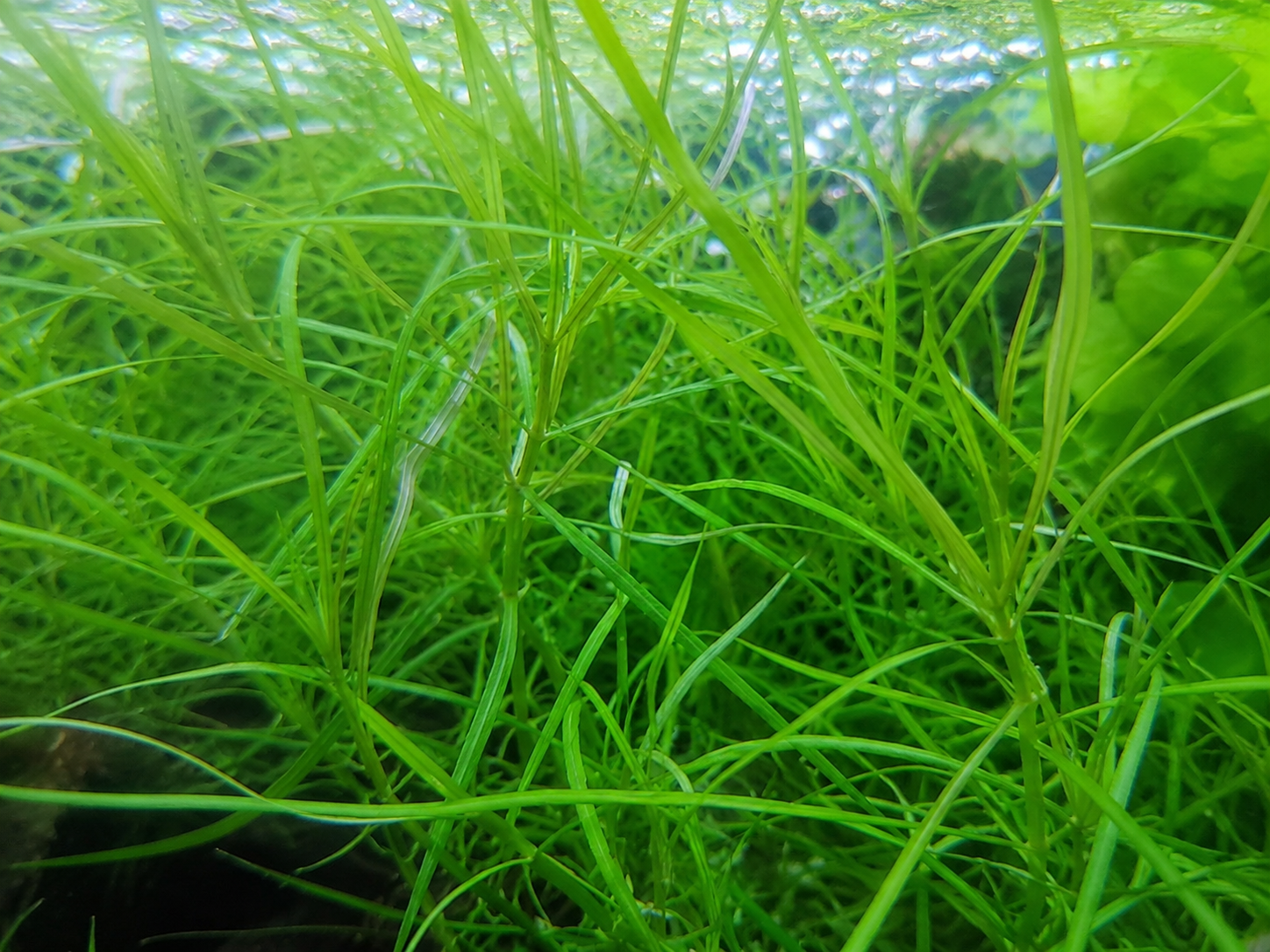
The leaves are arranged in pairs and divided into fine, hair-like segments forming a semicircular fan pattern. The result is a soft, feathery appearance quite different from typical stem plants. Dense groups look like soft green clouds against the back glass.
Height and Placement
Cabomba reaches 20–60 cm under typical aquarium conditions — a background plant. Plant in groups of 5–8 stems and trim regularly to prevent the plant from reaching the surface and flattening out.
Water Parameters
Cabomba is more flexible on temperature than it’s often given credit for — it grows well across the standard tropical range, 68–82°F (20–28°C), including the warmer end most betta and community tanks run at. Soft to moderately hard water and a pH of 6.0–7.0 give the best results. Weekly 20–25% water changes help maintain the stability this plant is sensitive to.
Feeding and Care
Cabomba is one of the more nutrient-sensitive fine-leaved plants. It absorbs nutrition largely through its leaves and appreciates Seachem Flourish dosed consistently each week. Seachem Flourish Tabs near the rooted base support the root system and help anchor the plant, which can float free in low-flow tanks.
How to Plant
Cabomba stems break easily — plant with care. Trim away any damaged or bare lower portion and push each stem 2–3 cm into the substrate using very fine-point tweezers. Push slowly and straight down; don’t angle or force. Plant in groups of 5–8 stems, spacing them 3–4 cm apart along the back of the tank. It’s easiest to plant Cabomba before filling the tank fully, or with the water level low, because the feathery leaves tangle together when fully submerged during planting. Push a Seachem Flourish Tab near the base of each group — the roots find it quickly.
Common Problems
- Shedding or falling apart. Usually a sign of inconsistent fertilizing rather than temperature — check water column dosing first.
- Wiry, stretched growth. More often a light or nutrient gap than a temperature issue; step up liquid fertilizing and check light intensity before anything else.
- Floating loose stems. Not actually a problem — a healthy floating cutting will keep growing and can simply be replanted or left to drift.
Pests
No pest issues specific to this plant. Rinse and check new stems for hitchhiker snails before adding them to an established tank.