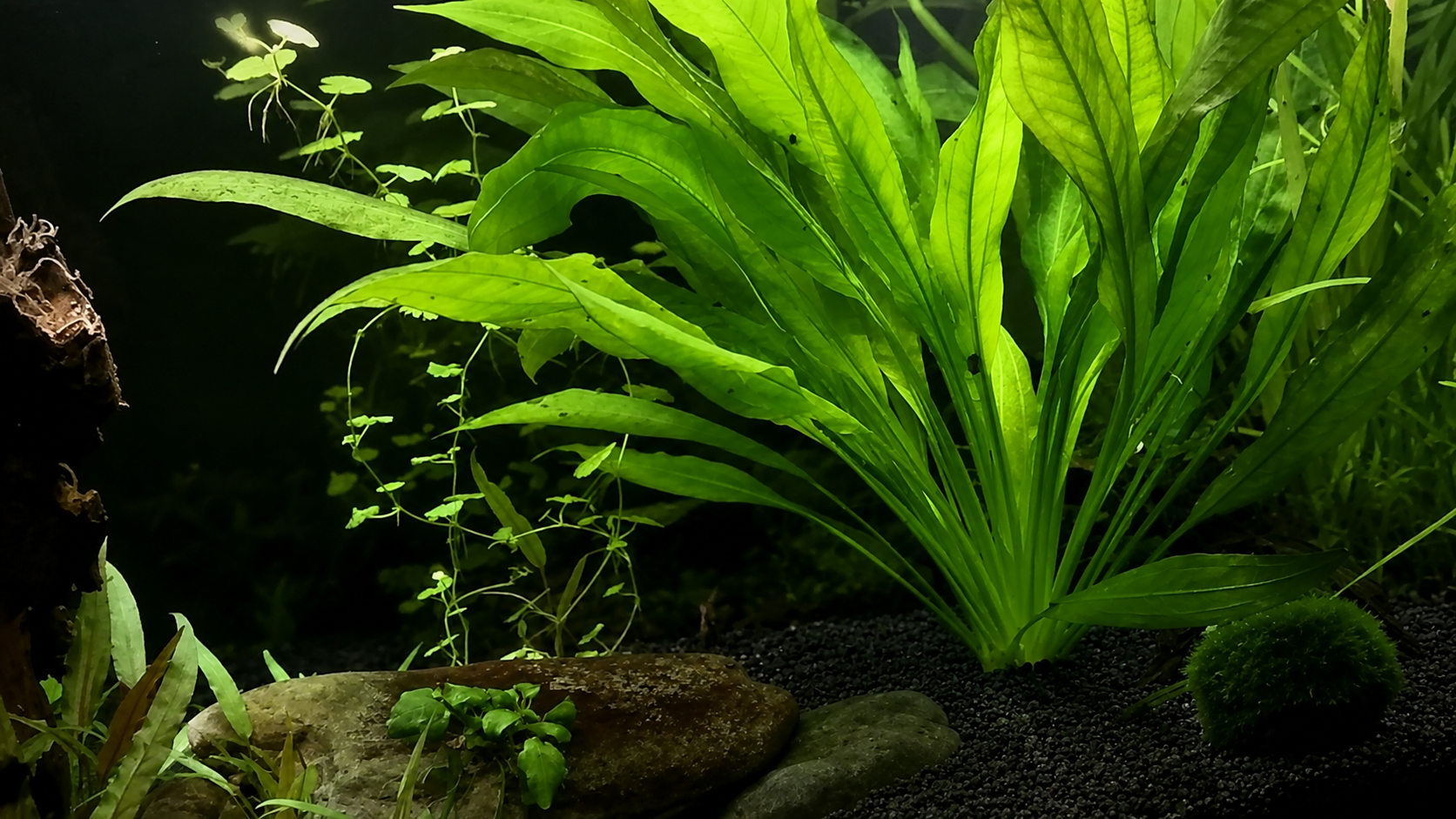
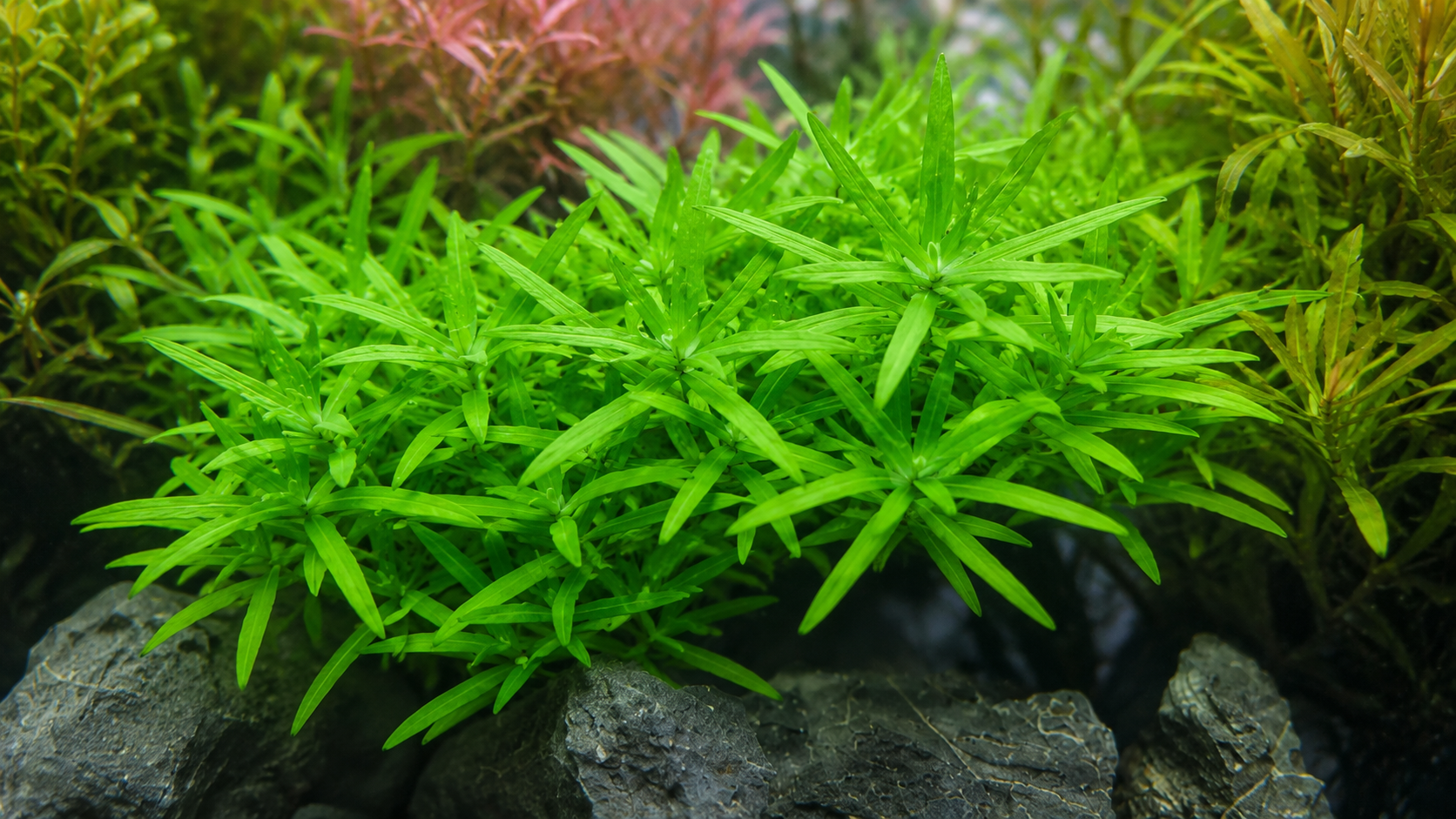
Heteranthera zosterifolia — Stargrass — is a South American native found in the Rio Paraná basin and neighboring river systems of Brazil, Argentina, and Paraguay. Unlike most background stem plants with oval or round leaves, Stargrass produces bundles of thin, grass-like leaves at each node that radiate outward in a star pattern. From a distance, a group of stems looks like a cluster of small underwater stars.
What Makes It Distinctive
The leaves are linear and strap-shaped — narrow, parallel-veined, and roughly 3–6 cm long — arranged in clusters at each stem node. No other common aquarium plant looks quite like it, making it an interesting texture contrast in a tank dominated by round or oval-leaved plants.
Size and Placement
Stargrass reaches 20–40 cm, firmly in the background category. Plant in groups of 5–8 stems for the star-cluster effect to read well from the front of the tank. Individual stems are visually weak; groups are striking.
Color
Consistently bright to medium green. No significant color change with light intensity, though growth becomes more compact and dense under stronger light.
Water Parameters
Tropical South American river conditions suit it well: 72–82°F (22–28°C), pH 6.0–7.5, and it’s tolerant of a range of hardness levels. A standard weekly 20–25% water change keeps it healthy.
Light and Care
Stargrass is adaptable and does well under moderate light without CO2. It’s not a demanding plant in terms of water chemistry or parameter specifics. Seachem Flourish Tabs near the stem bases provide root nutrition and prevent the lower-node leaf drop that happens when substrate nutrients are depleted. Seachem Flourish liquid weekly rounds out the feeding.
It can bloom emersed with tiny blue flowers — a nice bonus if you ever grow it above the water line.
Trimming
Trim regularly when stems reach or approach the surface. Cut and replant tops directly — the stump will branch readily. Dense, regularly trimmed groups maintain the star-pattern leaf arrangement far better than tall, spindly stems.
How to Plant
Strip the lower leaf pairs and push each stem 3–4 cm into the substrate using tweezers. Plant in groups of 5–7 stems spaced 3–4 cm apart. The distinctive star-shaped leaf whorls read best in the midground or at some distance in a larger tank — position the group where the leaf pattern is clearly visible rather than obscured behind other plants. Push a Seachem Flourish Tab near the base of each stem cluster at planting.
Common Problems
- Sparse, weak-looking growth. Almost always a planting-density issue — a few scattered stems look thin no matter what; plant in tight groups from the start.
- Lower node dieback. A sign the substrate has run out of nutrients; a root tab resolves it.
- Getting lost among other background plants. Because the star pattern needs some visual space to read, avoid crowding it directly against faster, denser neighbors.
Pests
No specific pest issues. Rinse and check new stems for hitchhiker snails before adding them to an established tank.