
Phyllanthus fluitans — Red Root Floater — is native to South America, found floating in slow-moving rivers, flooded forests, and calm backwaters from Brazil through to Venezuela and Colombia. It belongs to the family Phyllanthaceae, completely unrelated to other floating aquarium plants, which helps explain why it looks so unique.
The name tells the story: the roots are bright red to deep crimson, hanging downward in a dense curtain below the floating leaves. Under strong light, the leaves themselves develop red-orange tints around the edges and undersides. When a healthy colony covers part of a tank’s surface, the visual impact is extraordinary — especially when viewed from the front through glass.
Color and Light
Under low light: Leaves are medium green, roots are a muted pink-red. Under moderate-strong light: Leaves develop warm orange and red tones on the undersides and margins; roots deepen to vivid crimson. The color shift is one of the most dramatic light-response changes of any floating plant.
Low nitrates are also key to getting that bright fluorescent red we are all looking for!
Low humidity above the water surface also matters — Red Root Floater doesn’t do well under very wet conditions. Removing the lid is ideal.
Leaf Structure
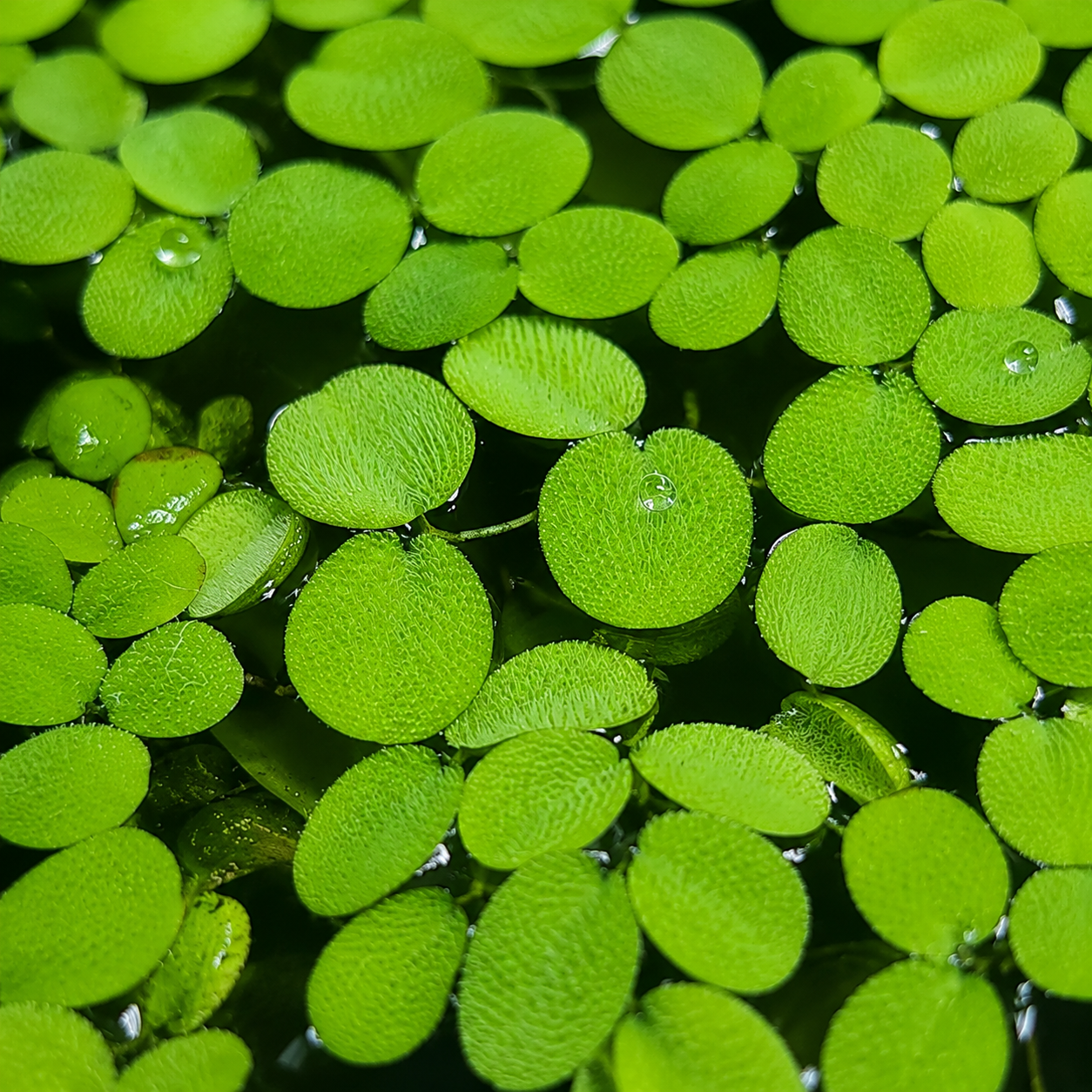
Each plant is small — individual leaves 1–2 cm across — with a neat, round form and a slightly folded shape at the midrib. Leaves have a fine coating of tiny hairs on the upper surface that trap air and make them water-repellent. The underside is reddish when the plant is healthy.
Water Parameters
It prefers warm, calm, slightly acidic water in line with its South American backwater origin: 74–82°F (23–28°C), pH 6.0–7.0. Low nitrate levels matter for color as much as any single parameter — see above.
Benefits
- Betta and fry cover: Dense floating colonies provide excellent refuge.
- Nitrate removal: Fast grower under good conditions; pulls nitrogen from the water efficiently.
- Visual impact: No other common floating plant produces the same combination of red roots and colored leaves.
Feeding
Seachem Flourish weekly is important — Red Root Floater responds more visibly to fertilization than most floaters. Under-fertilized plants lose their red coloration first, becoming progressively greener and then yellowing at the margins.
Care Notes
This plant needs still or very slow-moving water. Strong surface agitation damages the small leaves and prevents spreading. Keep flow low and the surface calm.
How to Plant
Place plants directly on the still water surface — Red Root Floater floats without any anchoring and the roots hang freely below automatically. This plant is particularly sensitive to surface agitation: even moderate flow damages the tiny leaves and prevents spreading. Keep the filter outflow submerged and angled away from the surface, and avoid powerheads or significant surface ripple. In suitable conditions — still water surface, good light above the tank, and weekly Seachem Flourish — the plants establish quickly and spread steadily.
Common Problems
- Staying green instead of red. Check light intensity, nitrate levels, and fertilizing routine — all three influence color, and this plant needs the right combination of all of them.
- Melting or dying back. Almost always surface agitation; still water is non-negotiable for this species.
- Slow spreading. Usually a fertilizing gap — this plant responds visibly to consistent liquid dosing more than most floaters.
Pests
No specific pest issues. As a fully floating plant it doesn’t carry the hitchhiker-snail risk that substrate or moss-grown plants do.