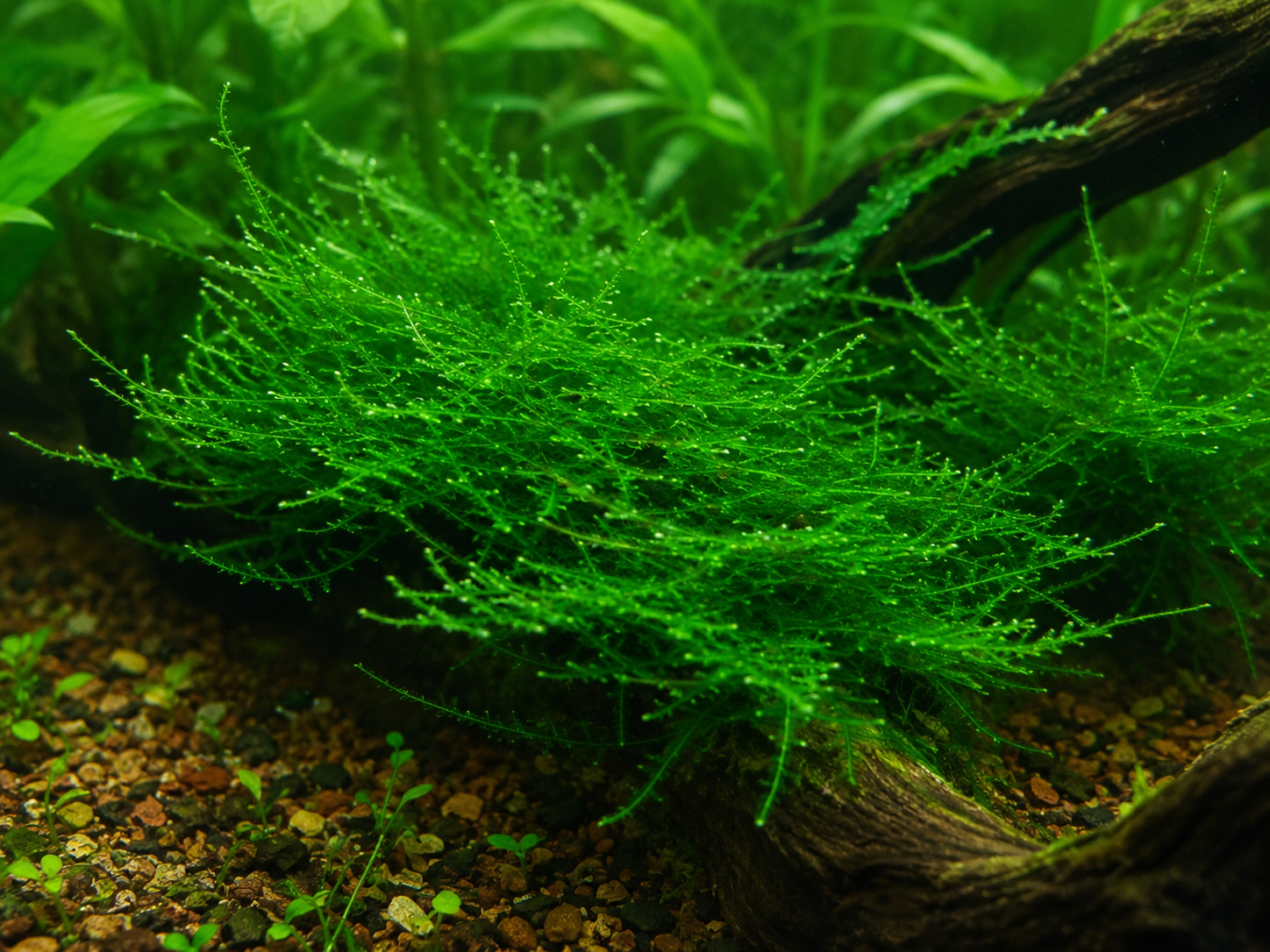
Taiwan Moss (Taxiphyllum sp. “Taiwan”) is a close relative of Java Moss, originally collected and introduced to the hobby from Taiwan. Taxonomically it remains an unresolved species in the Taxiphyllum genus, but in terms of aquarium care it behaves nearly identically to Java Moss with one key distinction: the individual leaves and branches are finer and more closely spaced, creating a denser, more compact mat.
How It Differs From Java Moss
Side by side, Java Moss has a looser, more open branching structure with slightly broader individual leaves. Taiwan Moss is more compact — the branches subdivide more finely and lie closer together, producing a tighter, more refined texture. When trimmed and kept on a flat surface, Taiwan Moss creates a velvety carpet effect that’s closer to a true aquascape carpet than Java Moss achieves.
Both mosses are equally easy and tolerant. Taiwan Moss is sometimes preferred for aquascaping where a cleaner, more uniform texture is desired.
Use and Placement
Tie or glue to driftwood, rocks, or mesh mats. Like Java Moss, it attaches via rhizoids over 2–4 weeks and eventually covers the entire surface of whatever it’s placed on. Works well:
- On small pebbles for a scattered “moss stones” look
- As a flat carpet on a mesh frame
- Packed into crevices in driftwood arrangements
- Loose in a breeding tank as fry refuge
Water Parameters
Similar tolerance to Java Moss: 64–82°F (18–28°C) with a wide water chemistry range. A standard weekly 20–25% water change is enough, and it will forgive longer gaps without serious harm.
Care
No substrate, no CO2 required. Seachem Flourish dosed weekly produces noticeably denser growth compared to unfertilized Taiwan Moss.
Under strong light it can grow quickly and produce new fronds that stand up above the surface of the mat — trim these to maintain a flat, uniform surface. Under low light, growth is slower and more prostrate, which actually gives a tidier appearance for carpet use.
For Shrimp Keepers
The fine-leaved structure of Taiwan Moss creates even more biofilm surface area per cubic centimeter than Java Moss. In shrimp tanks, a piece of Taiwan Moss is one of the best things you can add for grazing activity and enrichment.
Propagation
Like Java Moss, propagation is as simple as fragmentation — cut off a piece of any size and tie it to new hardscape, where it will continue growing independently.
How to Plant
Taiwan Moss attaches to surfaces rather than substrate. Tie small portions loosely to driftwood, rocks, or mesh using cotton thread or thin fishing line — don’t wrap so tightly that the moss is compressed into a solid ball. Alternatively, apply a small amount of aquarium-safe super glue gel to the surface of a rock and press the moss against it for 30 seconds. Within two to four weeks, fine rhizoids will grip the surface and begin true attachment. For a carpet mat, spread a thin layer between two pieces of mesh, tie or zip-tie the edges, and lay flat on the substrate. Dose Seachem Flourish weekly from the start.
Common Problems
- Fronds standing up instead of lying flat. A light-driven growth habit — trim the upright fronds to restore the flat, velvety look.
- Browning or thinning mats. Usually low flow trapping debris or a fertilizing gap, exactly as with Java Moss — thin the mat and add regular liquid fertilizer.
- Hitchhiker snails. As with any dense moss, store-bought portions can carry snail eggs — rinse and inspect before adding to a snail-free tank.
Pests
No pest issues beyond the usual hitchhiker-snail risk common to all dense mosses. Rinse and inspect new portions before adding them to an established tank.