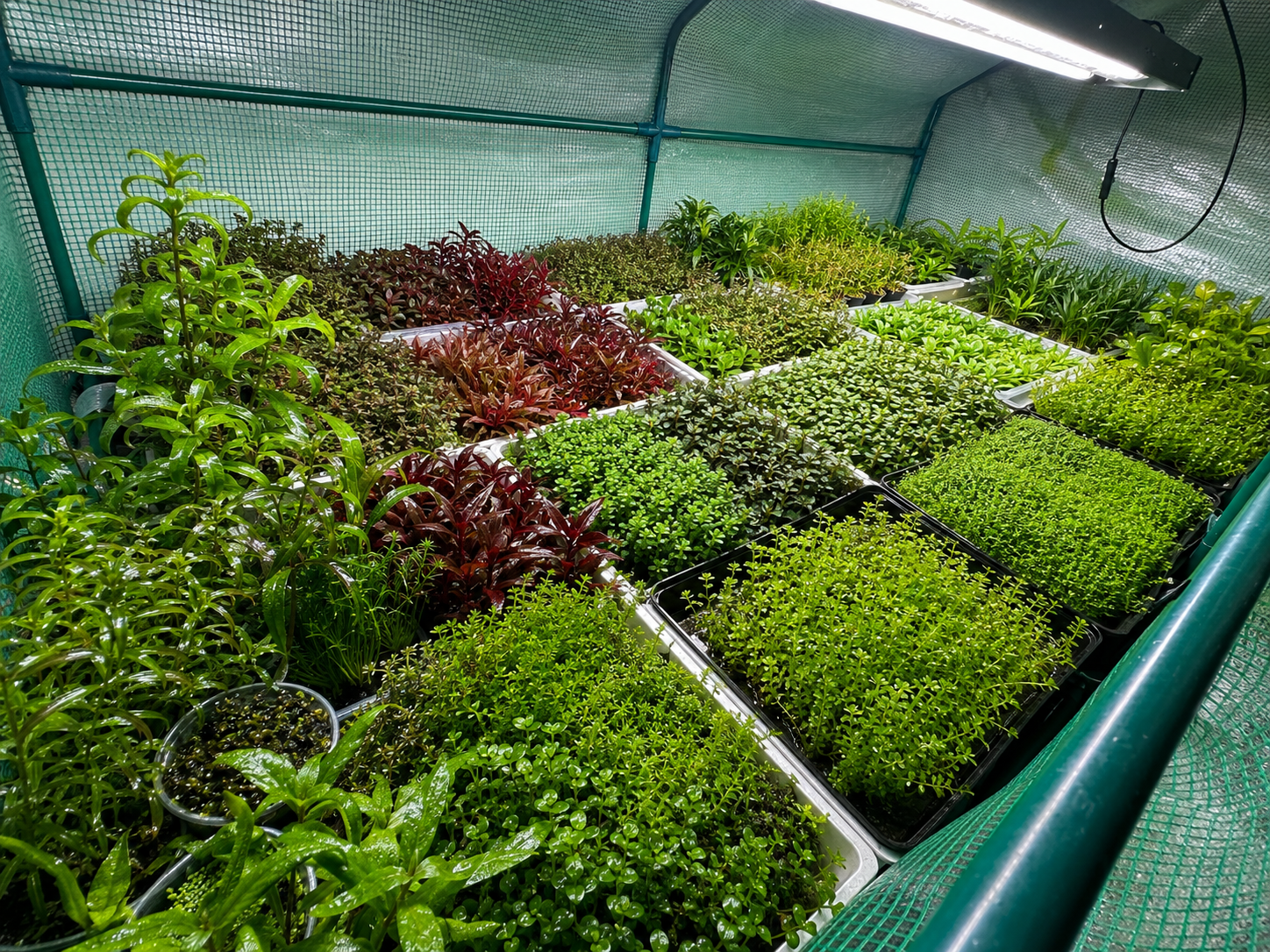
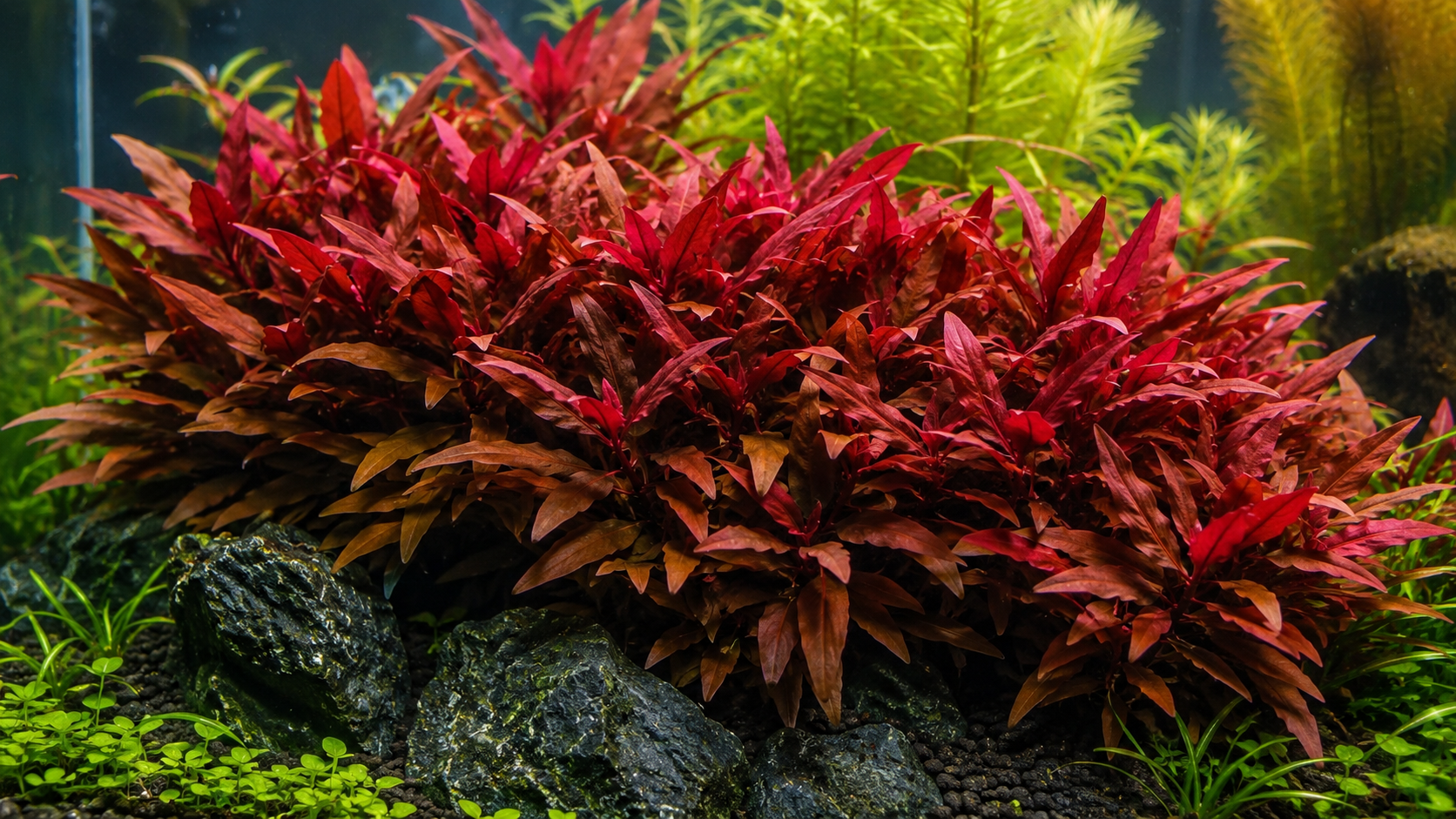
One of the first red plants we acquired, Alternanthera reineckii is the plant that delivered red colors without CO2. Native to the marshes and riverbanks of South America — primarily Brazil, Paraguay, and Argentina — it grows as a semi-aquatic plant in the wild, which is part of why it adapts so readily to home aquariums.
Color: What to Expect
Under decent light, AR goes pink to magenta, with the undersides of the leaves staying a deeper rose. Under stronger light it shifts toward a vivid brick red across the whole leaf. The color is driven more by light intensity than by CO2, which makes this one of the few genuinely colorful stem plants that performs in a low-tech setup. See how to get red aquarium plants to actually turn red for more on the mechanism behind this.
Rosaefolia is a variety (classified as a synonym of A. reineckii) with slightly broader, more ruffled leaves and a deep magenta-pink coloration that holds even under moderate light. It’s a bit more demanding than the base species but not dramatically so.
For both variations, the more light you give them, the more red they become.
Placement and Size
Both plants reach 20–50 cm under good conditions, making them true background plants. Plant them in groups of 5–7 stems for maximum visual impact. They look best behind shorter midground plants, where the red mass creates contrast against green stems in front.
Water Parameters
As a South American marsh plant, it prefers warm, slightly soft-to-neutral water: 72–82°F (22–28°C), pH 6.0–7.2. A standard weekly 20–25% water change keeps it stable — this is one of the pickier stem plants on this list about consistency, so try not to let maintenance slide for long stretches.
Feeding the Roots
AR is a stem plant that roots into the substrate, and it responds well to root nutrition. Push a Seachem Flourish Tab into the gravel near the stem bases every three months or so. Combined with weekly doses of Seachem Flourish liquid, this keeps growth steady and colors saturated even without CO2.
Without adequate nutrients, the lower leaves will lose color and eventually drop, leaving bare stems. Start feeding proactively before this happens.
In our aquariums we find that extensive root tab usage keeps Alternanthera growing fast and colorful. It’s highly recommended for this plant specifically.
Trimming and Propagation
When stems get leggy, cut them at mid-height and replant the top cuttings directly into the substrate. The trimmed base will produce 2–3 new side shoots within a week or two. Over time this gives you a fuller, bushier clump rather than a few tall bare stems.
Trim regularly — AR looks its best at 15–25 cm when leaves are densely packed and color is uniform throughout.
How to Plant
Strip the lowest two or three leaf pairs from each stem to expose a bare node section. Using tweezers, push each stem 3–4 cm into the gravel or sand — buried nodes root within a few days. Plant in groups of 5–7 stems spaced 3 cm apart along the back of the tank; the red color reads best when viewed from the front, so position the group against the back glass. Push a Seachem Flourish Tab near the base of each cluster immediately at planting to fuel root development from day one.
Common Problems
- Fading or reverting to pink. Usually a fertilizing lapse rather than a light problem for this particular species — check root tab frequency before adjusting light.
- Bare, leggy stems. The standard unfertilized-stem-plant issue; regular root tabs and trimming both prevent it.
- Slower establishment than other red stems. AR can take a bit longer to hit its stride after planting compared to something like Rotala — give it a few weeks before judging its performance.
Pests
No specific pest issues. Rinse and check new stems for hitchhiker snails before adding them to an established tank.