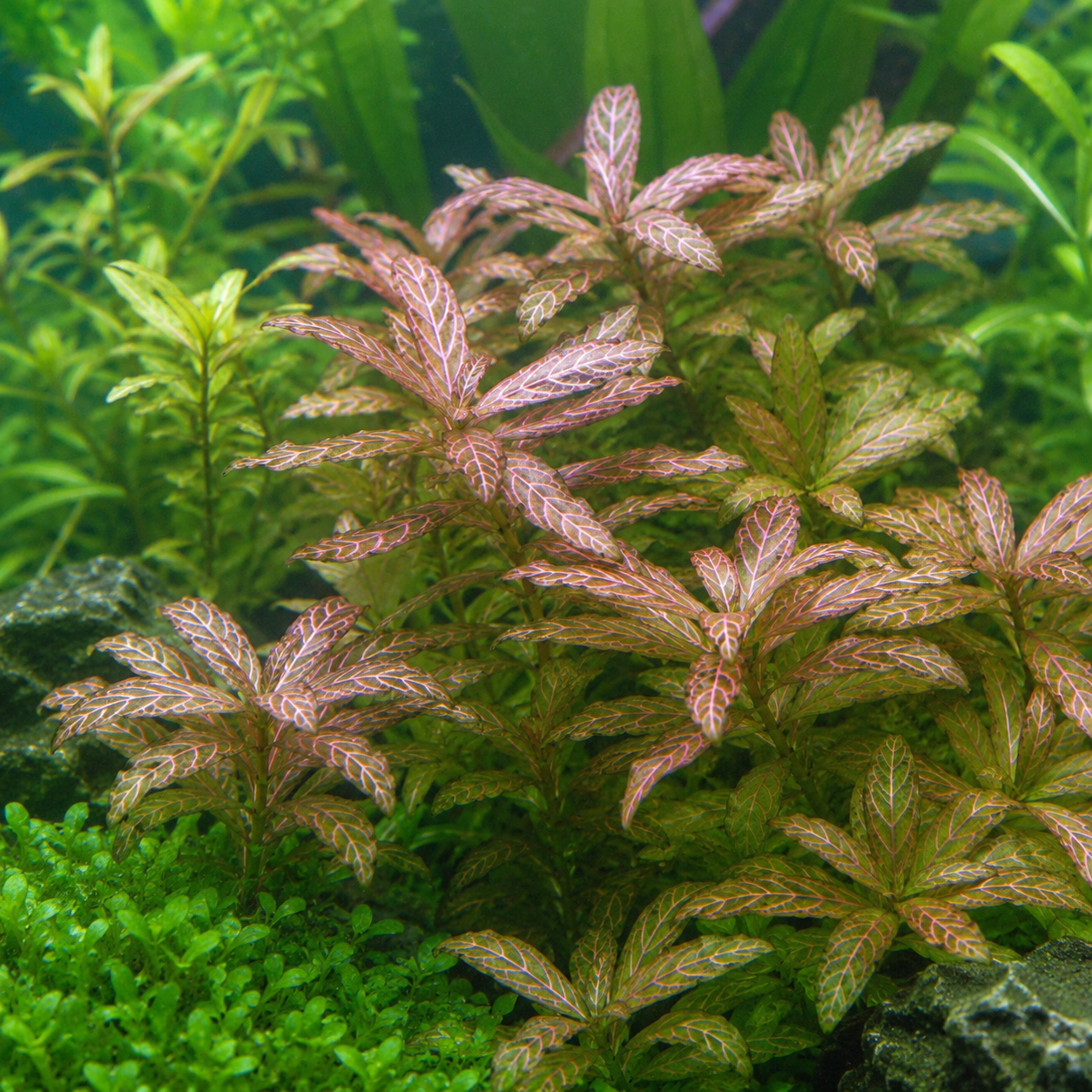
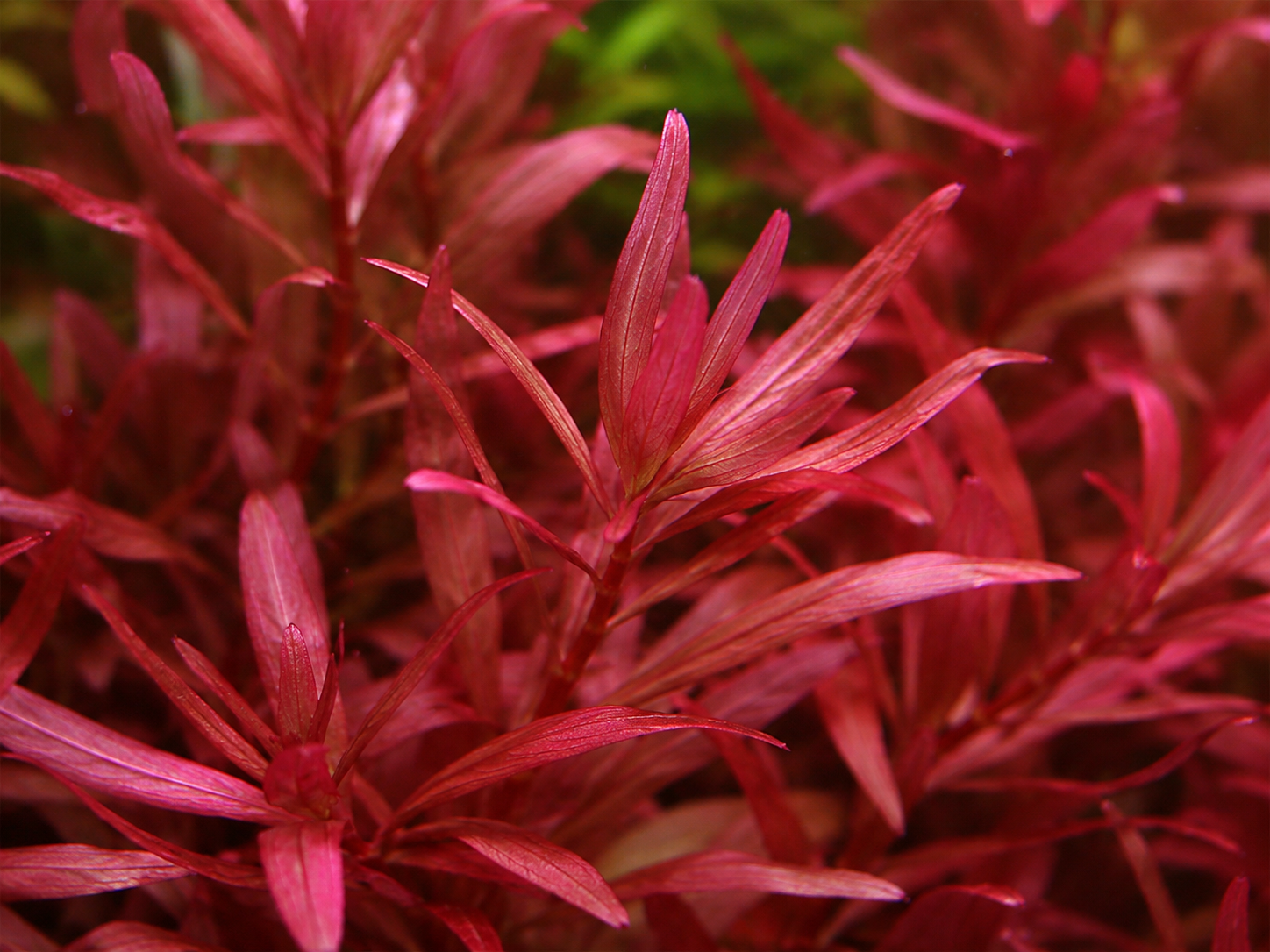
The Rotala genus gives aquarists some of the finest pink and red coloration in the low-tech planted tank. Three forms stand out for their range of intensity — Rotundifolia for soft pink, Blood Red for deep crimson, and H’ra for a unique orange-red that sits between the two.
Origin and Natural Habitat
Rotala rotundifolia is native to Southeast Asia — primarily India, Sri Lanka, and into the broader Indo-Pacific region — where it grows in rice paddies, shallow ditches, and along waterway margins. The species is highly adaptable, which explains its enormous popularity in the hobby.
Blood Red is a cultivated form selected for deeper pigmentation. H’ra (sometimes written Rotala sp. ‘H’ra’) was originally collected in Thailand and is considered a separate closely related species by many growers; it produces distinctly orange-red tones that are visually distinct from standard Rotundifolia.
Color Comparison
| Form | Low light | High light | Special notes |
|---|---|---|---|
| Rotundifolia | Yellow-green | Soft pink-orange | Most beginner-friendly |
| Blood Red | Pink | Deep crimson-red | Needs moderate+ light for full color |
| H’ra | Orange-green | Vivid orange-red | Distinct warm tone, very eye-catching |
None of these strictly require CO2, but CO2 injection causes noticeably more compact internodes and richer color. In a low-tech tank, good light and consistent fertilization will get you most of the way there — see how to get red aquarium plants to actually turn red for the full breakdown.
Height and Placement
All three reach 20–40 cm, making them background plants. Plant in dense groups of 7–10 stems for the best visual impact. Rotala’s small, oval leaves create a delicate feathery column of color against the back wall.
Water Parameters
Coming from warm, shallow Southeast Asian water, Rotala prefers 72–82°F (22–28°C), pH 6.0–7.5, and isn’t particular about hardness. A standard weekly 20–25% water change keeps it healthy — stability matters more than any specific number here.
Feeding for Color
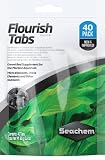
Rotala is a moderate feeder that uses both the water column and the substrate. Seachem Flourish Tabs near the stems ensure the roots have steady nutrition, while weekly doses of Seachem Flourish liquid maintain phosphorus and micronutrients in the water column. Phosphorus in particular drives the red pigmentation — plants growing in nutrient-poor water tend to stay green regardless of light.
Trimming
Trim just above a node when stems reach the surface. Replant the tops in groups for a denser look. Rotala branches readily from cut points, producing 2–4 side shoots. After a few trimming cycles, a single original stem becomes a full bushy clump.
How to Plant
Rotala stems are delicate — use fine-point tweezers and handle them gently. Strip the lowest pair of leaves and push each stem 2–3 cm into the substrate at a slight angle if needed to keep it stable. Plant in dense groups of 7–10 stems spaced 2–3 cm apart along the back wall. The dense-group effect matters more for Rotala than for most stem plants — thin plantings look sparse for weeks. Push a Seachem Flourish Tab near each group at planting to fuel early root establishment and bring the color out sooner.
Common Problems
- Staying green. Almost always a light or phosphorus issue rather than a health problem — see the feeding section above.
- Sparse, thin-looking growth. Usually a planting-density issue rather than a care problem; Rotala genuinely needs dense initial planting to look full.
- Snapped or floating stems. The stems are delicate and can snap during planting or maintenance — handle gently, and any broken piece can simply be replanted as a fresh cutting.
Pests
No specific pest issues. Rinse and check new stems for hitchhiker snails before adding them to an established tank.