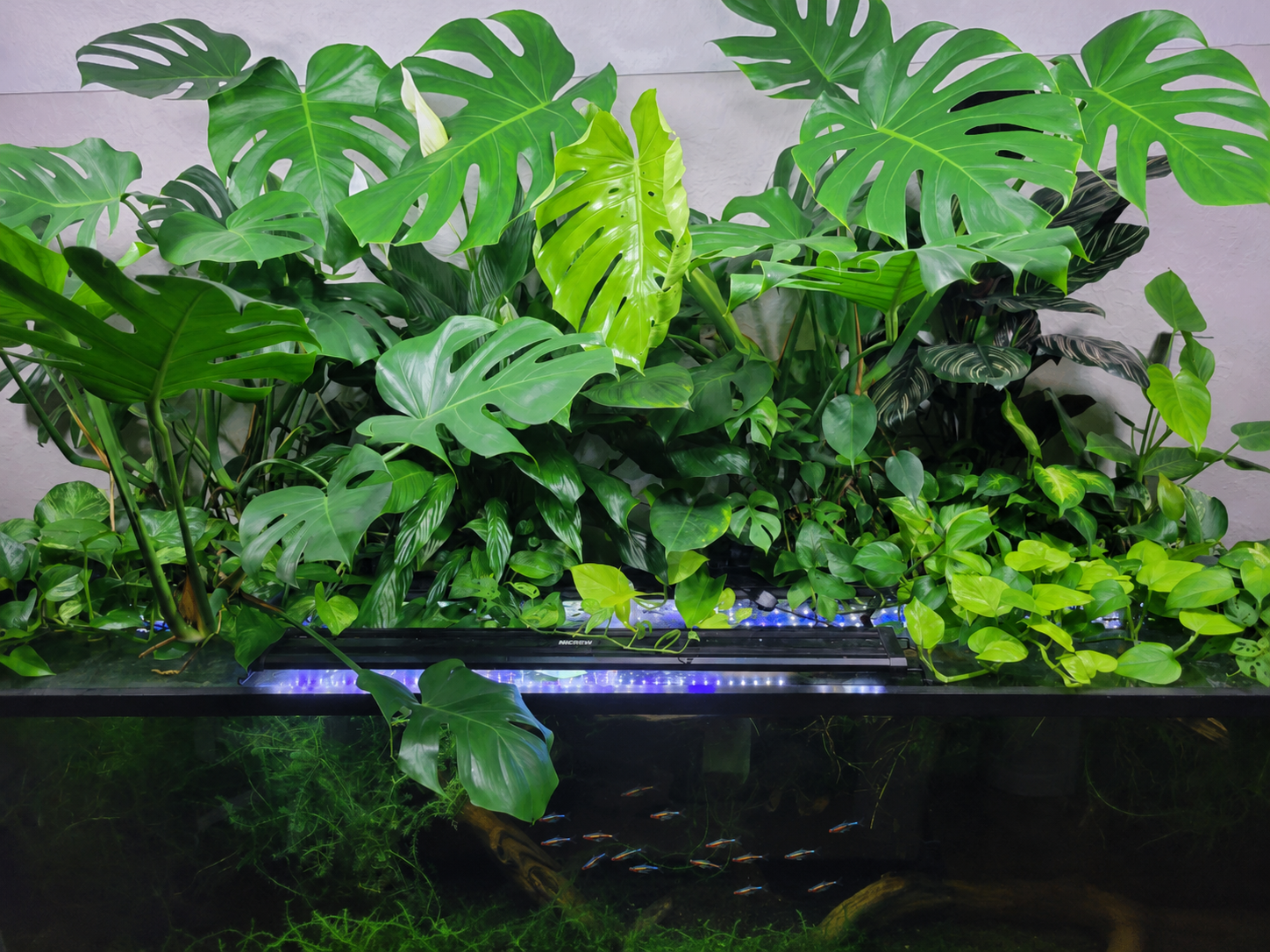
Most nitrate-export advice in this hobby centers on submerged plants — floaters, stem plants, carpets. But one of the cheapest, lowest-maintenance tricks in the book doesn’t grow underwater at all: root a common houseplant with its base in your tank water and let the foliage grow out into open air. The roots pull nutrients from the water column exactly like an aquatic plant would; the leaves get to grow above the rim instead of competing for space inside the tank.
Quick answer: can you put pothos roots in an aquarium?
Yes — pothos roots can grow directly in aquarium water as long as the leaves and crown stay above the surface. The roots absorb dissolved nutrients, especially nitrate, while the leaves grow in open air. Do not submerge the leaves. They will rot underwater and make the tank worse, not cleaner.
The simplest safe setup is a pothos cutting held at the back rim with only the lower node and roots in the water. Once white roots form, the plant can stay there permanently.
Why it works better than most aquatic plants
A submerged leaf is stuck pulling carbon dioxide out of water, where CO2 is scarce and diffuses slowly. A leaf growing in open air has essentially unlimited atmospheric CO2 available to it, so photosynthesis — and therefore nutrient uptake through the roots — runs much faster. That’s the same principle behind why emersed-grown plants establish faster than fully submerged ones, just pointed in the opposite direction: instead of a plant that will eventually go underwater, this is a plant that never does. The roots sit in your tank permanently; only the leaves live in air.
The practical result: a couple of vigorous houseplant cuttings can pull as much or more nitrate out of the water than a comparable mass of floating plants, using none of your tank’s swimming space or light.
Best species to use
- Pothos (Epipremnum aureum) — the standard choice. It roots readily in plain water, tolerates low indoor light, and grows almost indefinitely with roots permanently submerged. Extremely hard to kill.
- Philodendron (heart-leaf) — near-identical care to pothos, slightly glossier leaves, same rooting behavior.
- Peace Lily (Spathiphyllum) — a popular pick in aquaponics setups specifically for its nitrate appetite, with the bonus of white blooms if it gets enough light.
- Arrowhead Plant (Syngonium) — roots quickly and grows fast, with distinctive arrow-shaped leaves that add texture next to the rounder pothos and philodendron leaves.
All four are common, inexpensive houseplants — a single cutting from an existing plant (or a small pot from a garden center) is enough to start.
| Plant | Best reason to use it | Watch-out |
|---|---|---|
| Pothos | Easiest and most forgiving | Vines can get long fast |
| Heart-leaf philodendron | Similar to pothos with glossier leaves | Keep all leaves above water |
| Peace lily | Strong root mass and attractive foliage | Crown must not sit underwater |
| Syngonium | Fast roots and different leaf shape | Can get top-heavy if unsupported |
How to set one up
- Net breeder basket: Wedge a small net basket over the rim with the plant’s root ball or a stripped cutting resting inside, roots trailing down into the water.
- Drilled canopy or lid: A few holes sized to hold a stem let the plant sit with roots below and leaves resting on top of the hood.
- Floating anchor: A small foam disc or cork with a hole through the center holds a bare cutting upright, roots hanging below the float, leaves staying dry above the surface.
- Open-top tanks: If there’s no lid at all, simply prop a cutting against the back rim with the lower stem submerged — gravity and a bit of tape or a clip hold it in place until roots form.
The one rule across all of these: keep the leaves out of the water. Submerged pothos or philodendron leaves rot and foul the water instead of filtering it — only the roots and the very base of the stem should ever be wet.
Safety checklist before adding a cutting
Do this before the cutting touches the tank:
- Rinse soil off roots completely if using a potted plant.
- Remove any fertilizer pellets, perlite, or potting mix stuck in the root ball.
- Trim off damaged or mushy roots.
- Strip leaves that would sit below the waterline.
- Avoid cuttings that were recently treated with pesticide or leaf shine.
If you are not sure what was sprayed on a store-bought plant, root a clean cutting in a separate jar of water first, then move it to the aquarium once it has fresh roots.
Getting the roots established
Strip any leaves that would end up underwater, then hold the bare node section in the tank water using whichever method above suits your setup. Rooting takes roughly two to three weeks — white roots emerge from the nodes and gradually thicken. Nitrate benefits are minor at first and ramp up noticeably once the root mass fills out, so don’t judge the technique on week one.
Ongoing care
- Light: Indirect room light or a spot near a window is enough — these are houseplants, not aquatic plants, and don’t need aquarium-grade lighting to grow above the waterline.
- Trimming: Vines get long fast. Trim trailing stems and thin out excess roots with a pair of curved scissors once growth gets unruly — cuttings from a healthy plant can be rooted again to start a second one.
- Toxicity note: Pothos and philodendron leaves are mildly toxic if chewed by pets or curious kids, though they pose no risk to fish or shrimp since only the roots sit in the water. Keep trailing vines out of reach if you have a cat that likes to nibble.
What this trick does not replace
Houseplant roots are great nutrient export, but they are not a full filtration system by themselves. You still need normal aquarium basics: circulation, biological filtration, dechlorinated water, and regular observation. A pothos cutting can lower nitrate pressure, but it will not remove fish waste before bacteria break it down, fix ammonia in an uncycled tank, or compensate for heavy overfeeding.
Think of it as a living nitrate sponge, not a magic filter.
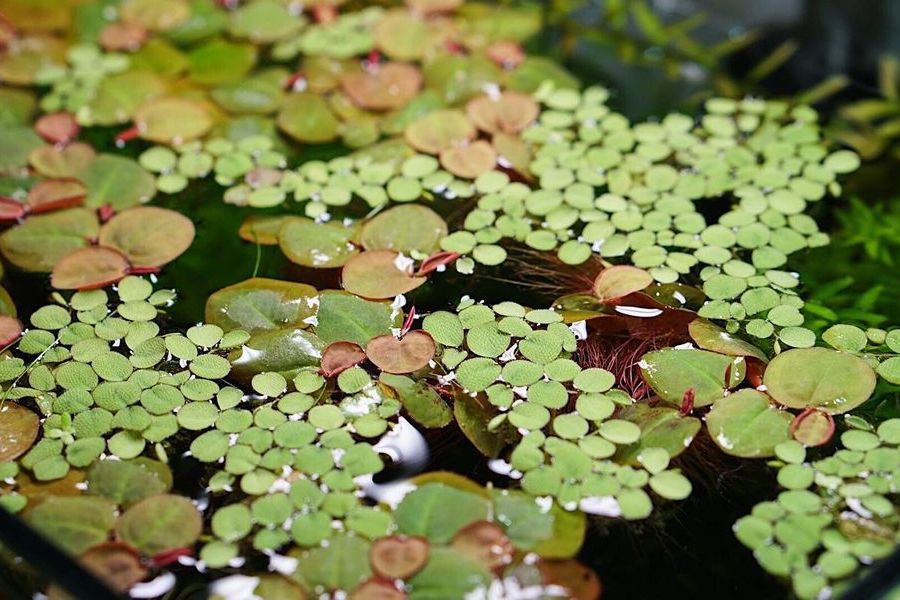
Combining with aquatic nitrate export
A houseplant rooted at the back of the tank pairs naturally with a floating plant layer at the surface — one handles nutrient export from above the waterline, the other from within it. Both fit the same low-effort philosophy behind a Walstad-style tank: let plants do the filtration work instead of leaning entirely on equipment. And unlike anything fully submerged, a trailing pothos vine gives the space above your tank as much personality as the aquascape below it.