If you’ve ever bought a plant that arrived looking a little different than the photos — thicker leaves, a slightly waxy texture, maybe a leaf or two that yellows and drops in the first week — you weren’t sold a bad plant. You were sold an emersed-grown one, and that’s actually the plant you want.
Quick answer: is emersed-grown better?
For most aquarium plants, yes. Emersed-grown stock is usually cleaner, tougher in shipping, and less likely to carry snails or algae. The tradeoff is that some old leaves may melt after planting while the plant switches to its underwater form. That transition is normal. You judge success by the new growth, not by whether every original leaf stays perfect.
What “emersed” means
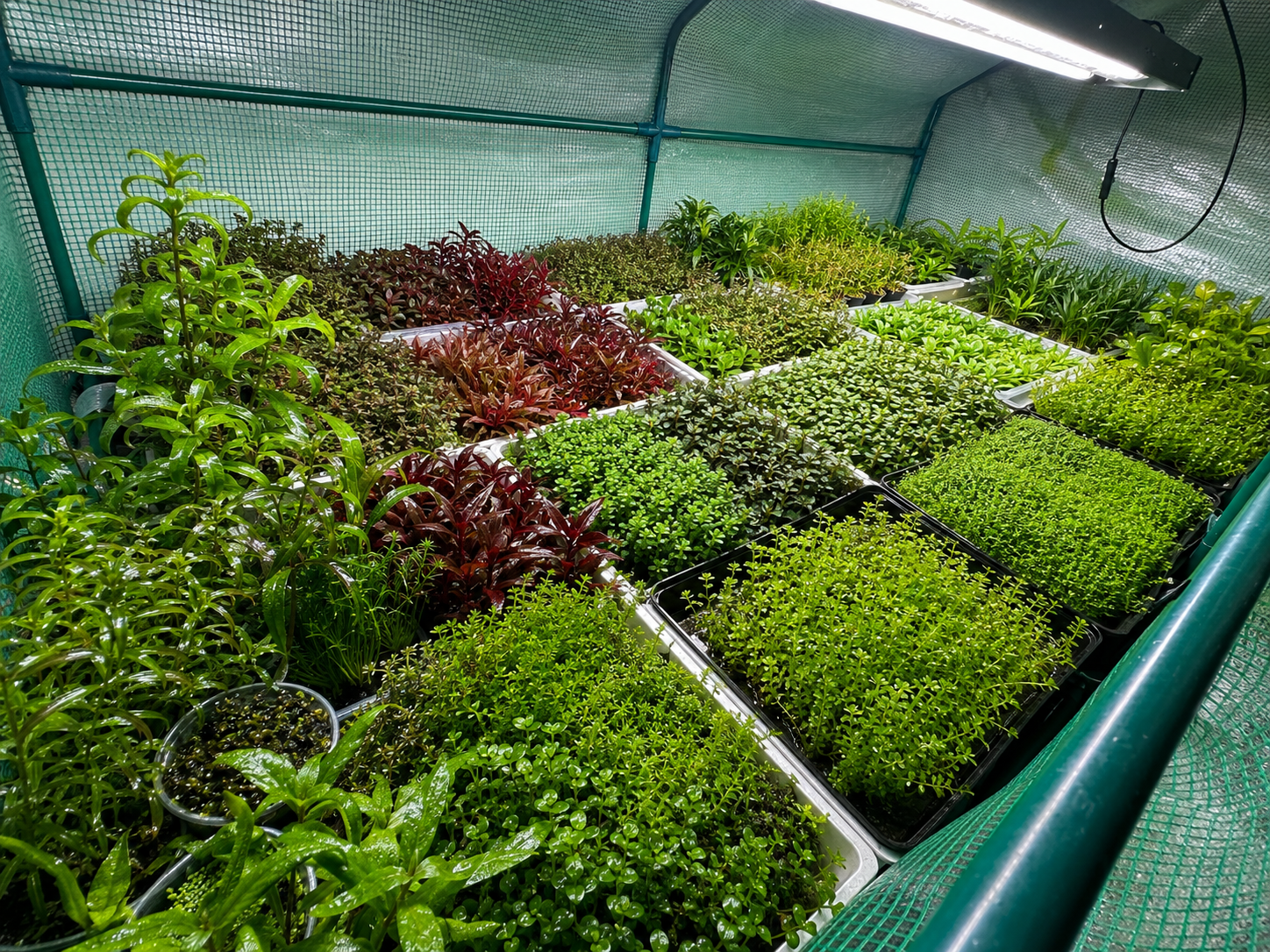
Emersed-grown plants are cultivated above the waterline, with roots in wet soil and leaves growing out in open, humid air — much like a normal houseplant — rather than fully submerged the way they’ll eventually grow in your tank. Commercial farms grow the vast majority of aquarium plants this way because it’s simply a better growing method for producing healthy stock at scale.
Why growers (including us) do it this way
- No snails, no pests. Submerged growing tanks are exactly the environment pest snails and their eggs thrive in. Emersed beds, grown in soil and open air, don’t harbor them — which is a big part of why we can ship snail-free.
- Tougher plants. Emersed leaves grow a thicker cuticle to resist water loss in open air. That same toughness means the plant tolerates the stress of shipping far better than a delicate, fully submerged leaf would.
- Faster, denser growth. Plants photosynthesize more efficiently in air, where CO2 is abundant, than underwater, where it’s often the limiting factor. Farms get thicker, more root-dense stock in less time.
- Reflexive rooting. An emersed plant’s root system is already built for soil contact. Once submerged, it adapts quickly and starts producing new growth suited to life underwater.
How emersed plants look different from submersed plants
The biggest confusion is visual. Many aquarium plants look like two different species depending on whether they were grown in air or underwater.
| Plant type | Emersed form often looks like | Submersed form often looks like |
|---|---|---|
| Stem plants | Shorter, firmer stems with thicker leaves | Softer, longer stems with thinner leaves |
| Crypts | Compact leaves, sometimes stiffer or more upright | Longer, softer leaves that wave in flow |
| Carpeting plants | Tight clumps with dense roots | Low runners spreading across the substrate |
| Rhizome plants | Smaller leaves and strong attachment roots | Larger leaves once settled underwater |
That is why online listing photos can feel misleading even when the plant is healthy. A farm-grown stem is not supposed to look exactly like a six-month-old underwater stem from a display tank.
What to expect after planting
This is the part that worries new aquascapers the most, so it’s worth saying plainly: some melting is normal. The old emersed-form leaves are built for air, not water, and many species shed them over the first one to three weeks as they redirect energy into new submersed-form leaves — which are typically thinner, more translucent, and better shaped for underwater light and flow. A plant that looks worse in week one and noticeably better in week three is behaving exactly as expected.
Use this timeline as a sanity check:
| Time after planting | Normal signs | Warning signs |
|---|---|---|
| Days 1-3 | Leaves perk up, some older leaves yellow | Stem base turns mushy immediately |
| Week 1 | A few air-grown leaves melt or detach | Entire crown/rhizome softens |
| Weeks 2-3 | New underwater leaves appear | No new growth and continued collapse |
| Weeks 4+ | Plant looks more like its aquarium form | Roots blacken, crown rots, or stem bases dissolve |
The important distinction is leaf melt vs. crown or rhizome rot. Leaf melt is part of conversion. A rotting crown, buried rhizome, or mushy stem base is a planting or health problem.
How to help the transition along
- Don’t panic-trim. Yellowing or melting leaves look alarming, but removing too much too soon can strip the plant of stored energy it needs to grow new leaves. Trim only what’s clearly dead and translucent; leave anything still green.
- Keep water parameters stable. The plant is already adapting to one major change (air to water) — stable temperature and chemistry during this window reduces additional stress.
- Go easy on light at first. Full-intensity lighting on a plant still converting its leaf structure can do more harm than good. A slightly dimmer setting for the first week or two, then ramping up, tends to produce a smoother transition.
- Feed lightly. A light dose of Seachem Flourish supports the new submersed leaves as they form, without overloading a plant that’s still adjusting.
What not to do
Most failed emersed-to-submersed transitions come from overreacting:
- Do not throw away a plant just because the old leaves melt in week one.
- Do not blast brand-new plants with high light for ten hours a day.
- Do not bury rhizome plants like Java Fern or Anubias to “help them root.”
- Do not move the same plant three times in a week because it looks unhappy.
- Do not dose aggressively to “force” growth before roots and new leaves have started.
The boring approach works best: plant correctly, keep conditions steady, trim only dead tissue, and watch for new growth.
Emersed vs. tissue culture vs. submersed-farmed
- Tissue culture (TC) cups are grown in sterile agar gel — guaranteed pest-free but usually smaller and slower to establish since the plant has to adapt from a lab environment rather than soil.
- Submersed-farmed stock is grown underwater from the start, which sounds ideal but is slower to produce and far more prone to carrying snails and other hitchhikers.
- Emersed-grown stock splits the difference: fast, robust growth with the pest-free reliability of a soil-based, above-water system — which is why it’s the standard across most of the hobby.
| Buying option | Best for | Main downside |
|---|---|---|
| Emersed-grown | Clean, sturdy plants that ship well | Some leaf conversion after planting |
| Tissue culture | Sterile starts for tiny carpets or rare plants | Small portions and slower establishment |
| Submersed-grown | Display-ready appearance immediately | Higher pest risk and more shipping stress |
Where you’ll see this in our lineup
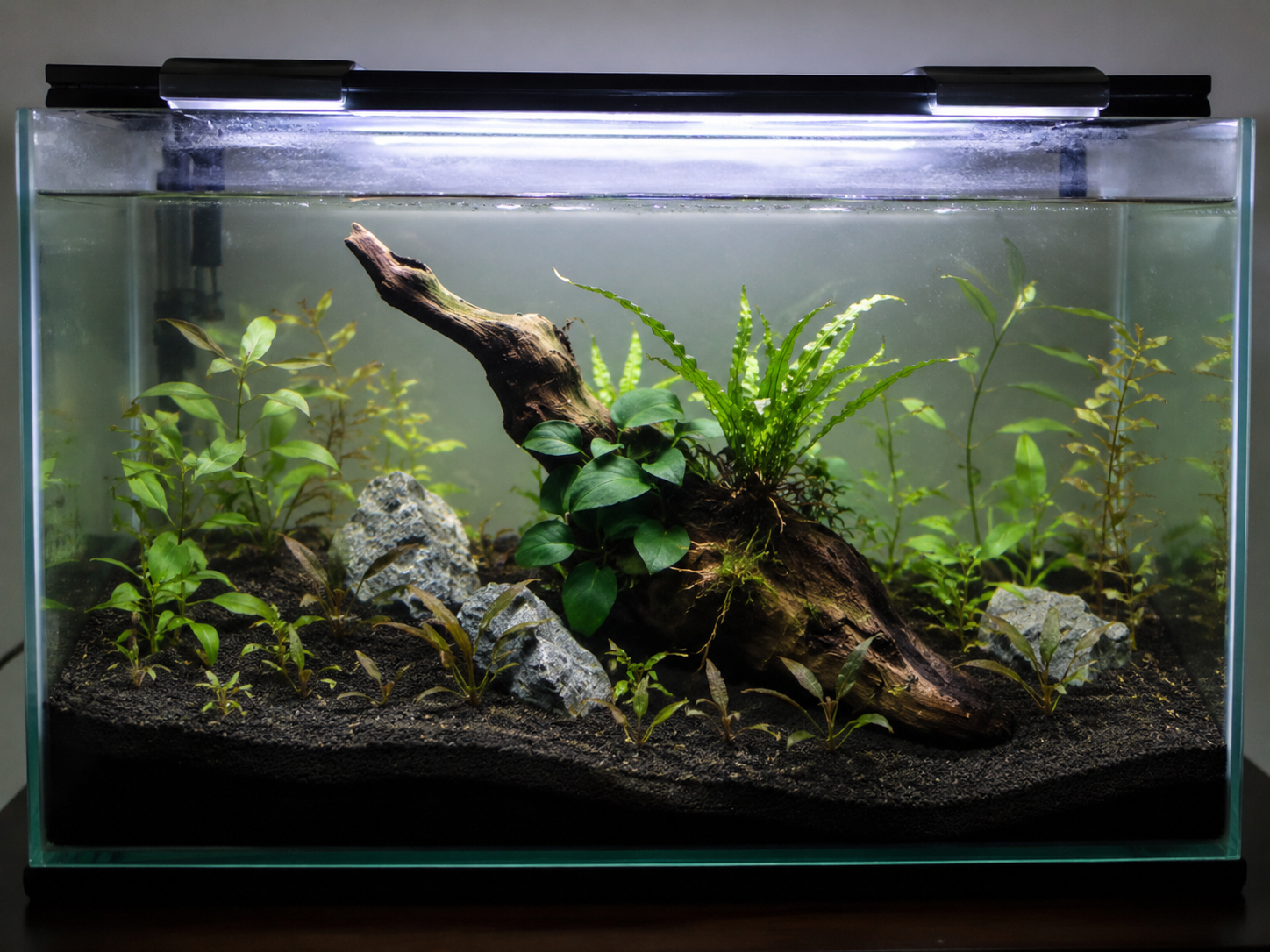
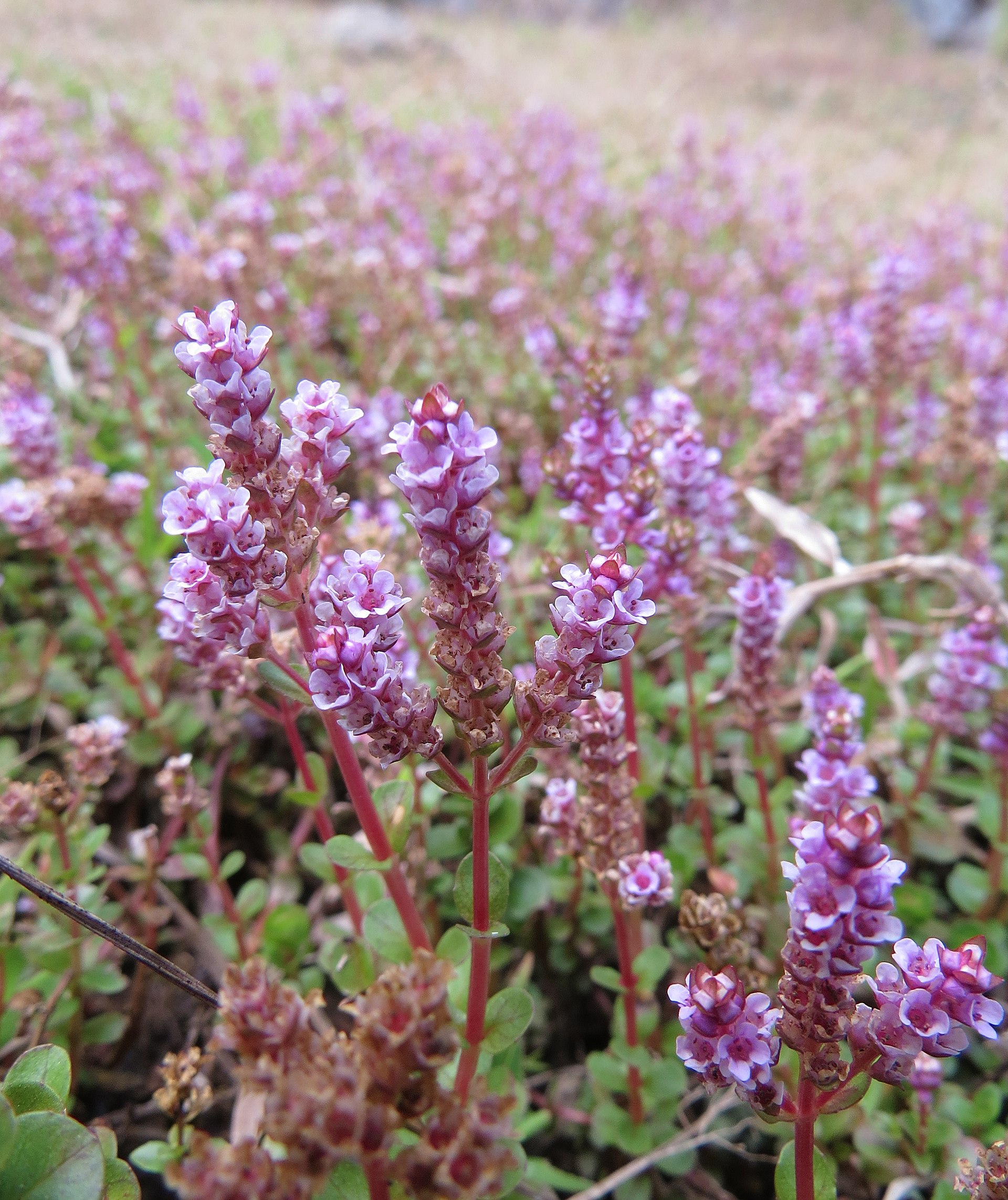
Most of what we grow and ship is emersed-cultivated, including the Cryptocoryne varieties, Anubias, Java Fern, Staurogyne Repens, Samolus Parviflorus, and the carpeting trio of HC Mini, Monte Carlo, and Glossostigma. If you’re building out a full low-tech layout, our best low-tech plants guide covers how these fit together once they’ve settled in.
The short version: if your new plant looks a little rough the first week, that’s the emersed-to-submersed conversion doing exactly what it’s supposed to. Leave it be, keep conditions stable, and the new growth will tell you it’s working.