“How many plants do I need?” is one of the most common questions we get before a first order ships, and it’s a genuinely hard one to answer with a single number — it depends on how densely you want the tank to look on day one versus how patient you are waiting for it to fill in. That said, a 10-gallon tank is common enough that we can give real numbers instead of a shrug.
The quick shopping answer
For a normal 10-gallon planted tank, start with 35-50 individual stems or plant portions total if you want it to look planted right away. A budget build can start around 20-30 stems/portions, but it needs fast growers and patience. A dense aquascape can use 60+ stems/portions, especially if you’re trying to cover the foreground from day one.
Here is the practical range we use when helping someone choose a bundle:
| Tank style | Good starting amount for 10 gallons | What it looks like on day one |
|---|---|---|
| Budget starter | 20-30 stems/portions | Clearly planted, but with visible open substrate |
| Balanced low-tech | 35-50 stems/portions | Filled-in without looking crowded |
| Dense aquascape | 60+ stems/portions | Near-finished layout immediately |
That range assumes a mix of stems, rooted plants, epiphytes, and floaters. If every plant is slow-growing Anubias or Java Fern, you need more hardscape coverage and more patience. If half the order is fast stems or floaters, you can start lighter because those plants fill space quickly.
Think in zones, not a total count
Rather than “how many plants total,” it’s more useful to plan by the three planting zones — see our guide to background, midground, and foreground plants if you haven’t picked species for each yet. For a standard 20“×10“×12“ 10-gallon tank:
- Background: 2-3 small bunches (5-7 stems each) along the back glass — around 15-20 stems total. Enough to create a screen without swallowing the whole tank.
- Midground: 3-5 individual plants (crypts, Anubias, or a Java Fern tied to hardscape) placed as accents rather than a solid wall.
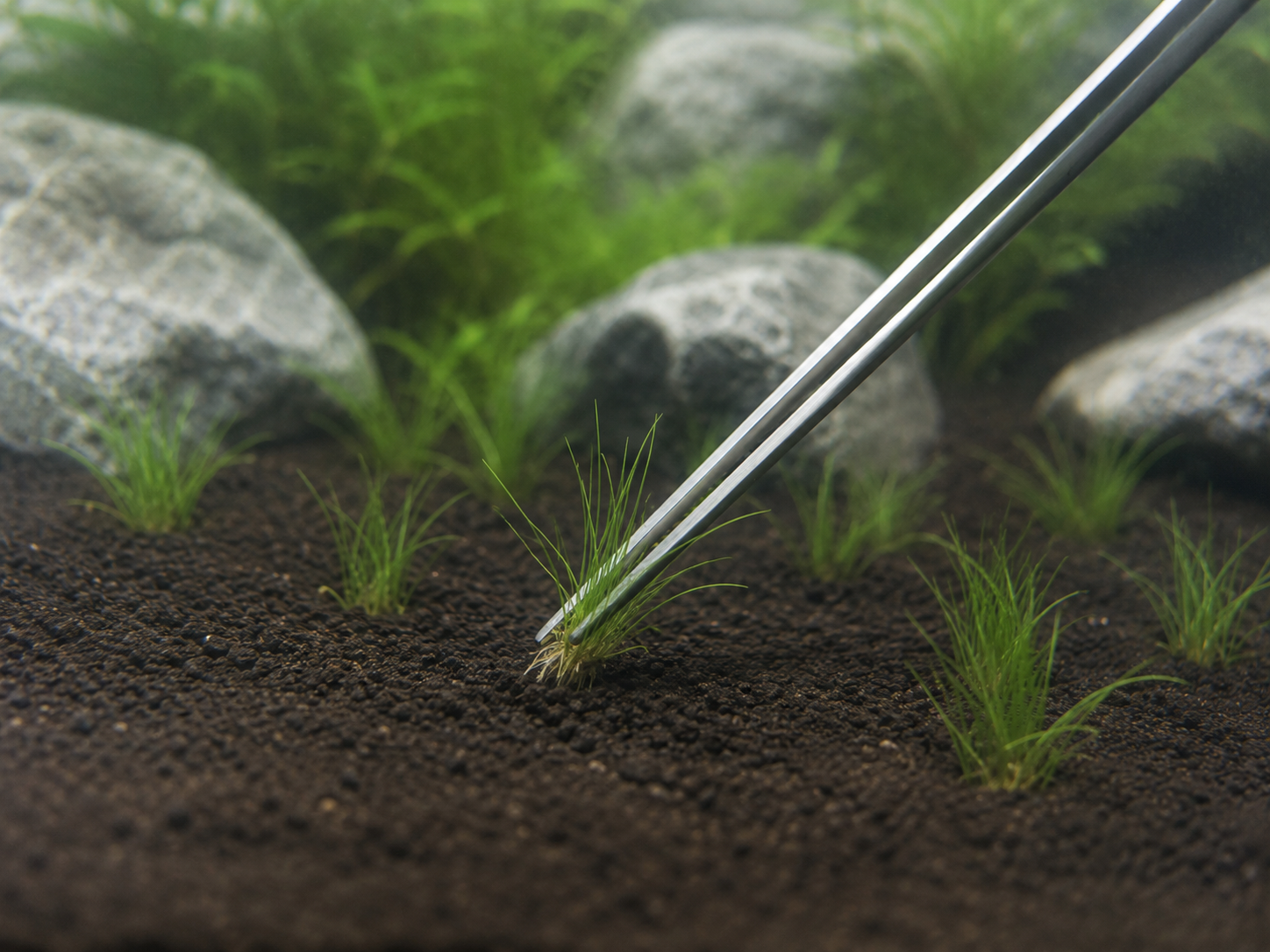
- Foreground: if you’re carpeting, expect to need more coverage than you think — a 10-gallon foreground realistically wants 15-20 small carpet portions to look intentional rather than patchy on day one, though most will spread and fill gaps within a few weeks.
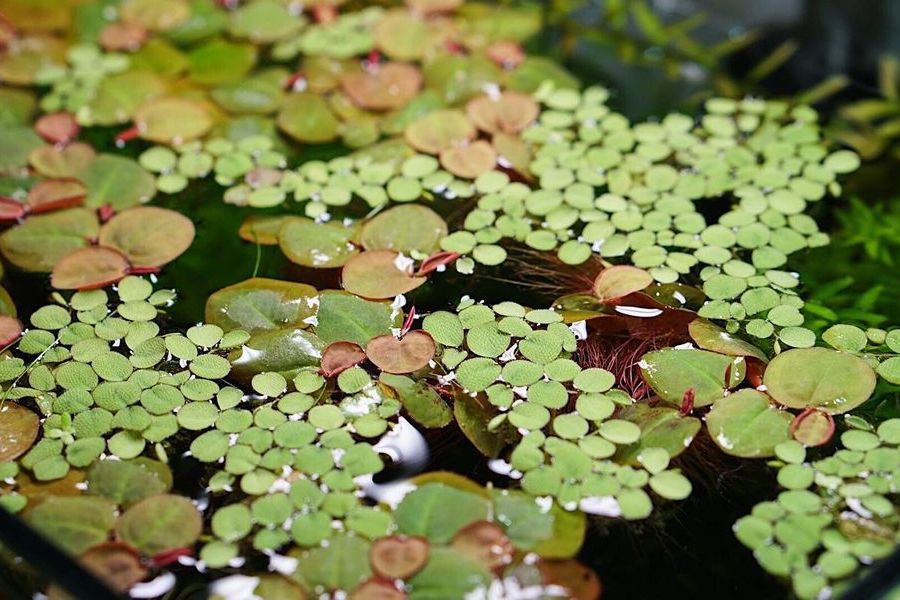
- Floating: a modest handful (10-15 individual plants) is enough to start a floating layer that will double or triple in a few weeks — see our floating plants guide for how much surface coverage to aim for.
A 10-gallon planting recipe that actually works
If you want a simple, balanced order without doing layout math, this is the baseline I would choose for a low-tech 10-gallon:
| Zone | Plant type | Starting amount |
|---|---|---|
| Back corners | Fast stems such as Hygrophila, Ludwigia, Bacopa, or Guppy Grass | 15-20 stems |
| Midground | Crypts, Amazon Sword babies, Dwarf Sagittaria, or Staurogyne | 4-6 plants/portions |
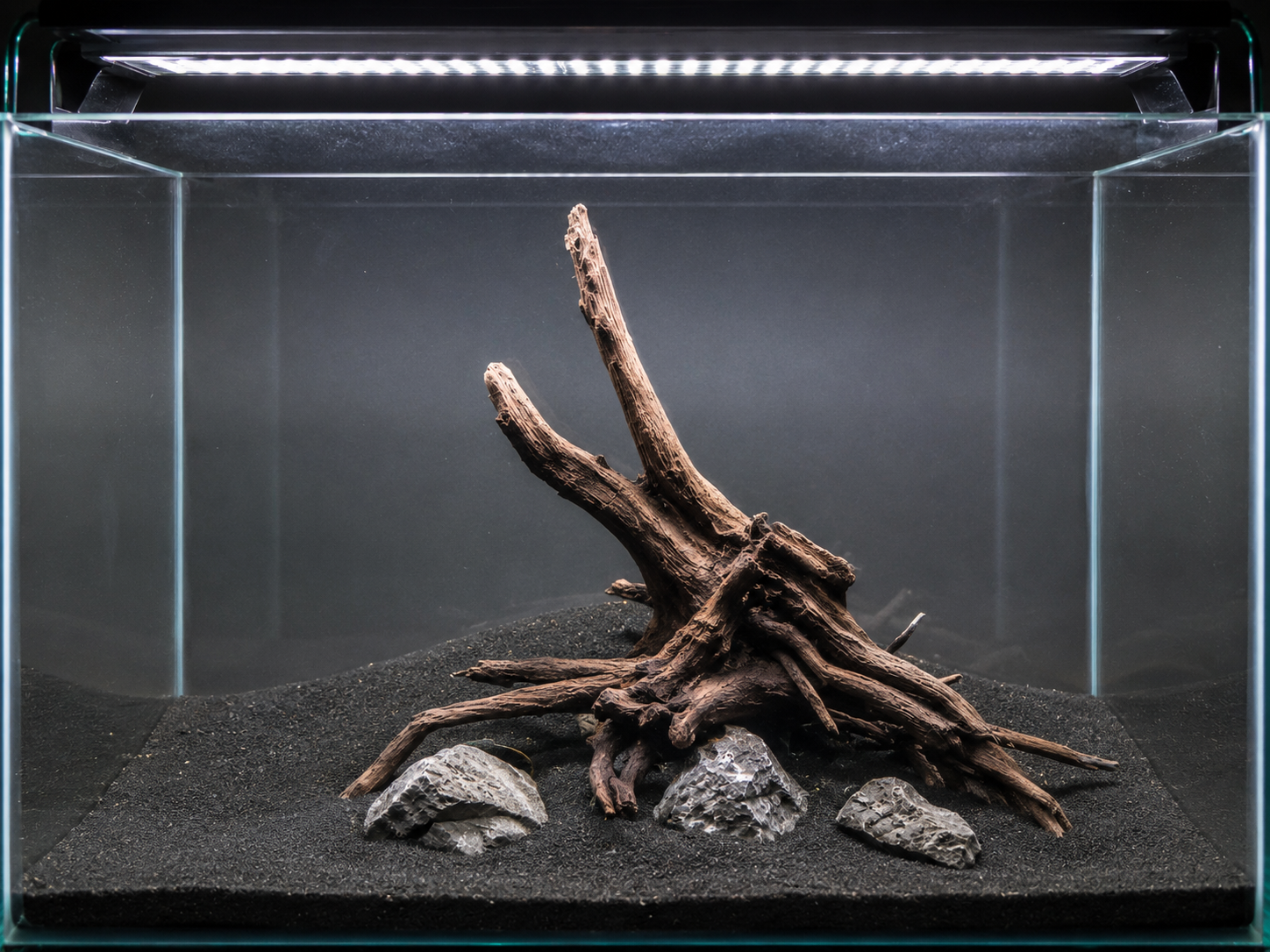
| Hardscape | Java Fern, Anubias, Bucephalandra, or moss | 2-4 rhizome/moss portions |
| Foreground gaps | Pearlweed, Monte Carlo, dwarf hairgrass, or dwarf sag | 8-15 small portions |
| Surface | Frogbit, salvinia, red root floater, or water lettuce | 8-15 floaters |
That gives the tank immediate height in the back, something substantial in the middle, and enough plant mass to compete with early algae. It also avoids the classic beginner mistake of buying one of everything and ending up with a collection instead of a layout.
Dense vs. patient
There’s no wrong answer between planting heavily on day one and planting sparse and waiting — it’s a budget and patience tradeoff:
- Plant dense if you want the tank to look finished immediately and don’t mind paying for more stock up front.
- Plant sparse and wait if budget matters more than instant gratification — fast growers like Hygrophila or Ludwigia will visibly fill gaps within 2-3 weeks, and slower growers like crypts and Anubias will take a couple of months either way regardless of how many you start with.
Either approach works. What doesn’t work is planting too sparse and picking only slow growers — that combination just leaves visible bare substrate for months, which is exactly the setup that lets algae get a foothold. See our algae guide for why that matters.
How many bunches is that at checkout?
Aquarium plants are sold in annoying units: bunches, pots, cups, rhizomes, mats, and loose floaters. A “plant count” only helps if you translate it into what you can actually buy.
- Stem bunch: usually 5-7 usable stems. Three bunches is enough to plant a visible background in a 10-gallon.
- Potted rooted plant: usually one main crown, sometimes with small offsets. Count each pot as one midground or background accent, not a whole zone.
- Rhizome plant: Java Fern and Anubias are bought by rhizome size, not stem count. One good rhizome can cover a small piece of wood; three or four can make hardscape look mature.
- Carpet cup or portion: one cup can be split into many plugs, but a true day-one carpet needs several portions spread across the foreground.
- Floaters: start small. Floaters multiply fast and can shade the whole tank if you begin with too much.
Scaling to a different tank size
Use the 10-gallon numbers above as a baseline and scale roughly linearly with footprint (not just water volume — a tall, narrow tank has less usable substrate than a short, wide one of the same gallonage). A 20-gallon long with double the floor space wants roughly double the stem counts; a 5-gallon nano wants about half.
| Tank size | Budget starter | Balanced low-tech | Dense aquascape |
|---|---|---|---|
| 5 gallons | 10-18 stems/portions | 18-30 | 35+ |
| 10 gallons | 20-30 | 35-50 | 60+ |
| 20-gallon high | 35-50 | 55-80 | 90+ |
| 20-gallon long | 45-65 | 75-110 | 125+ |
A 20-gallon long needs more plants than a 20-gallon high because the footprint is larger. Substrate area is what you are filling, not gallons of water.
A real example
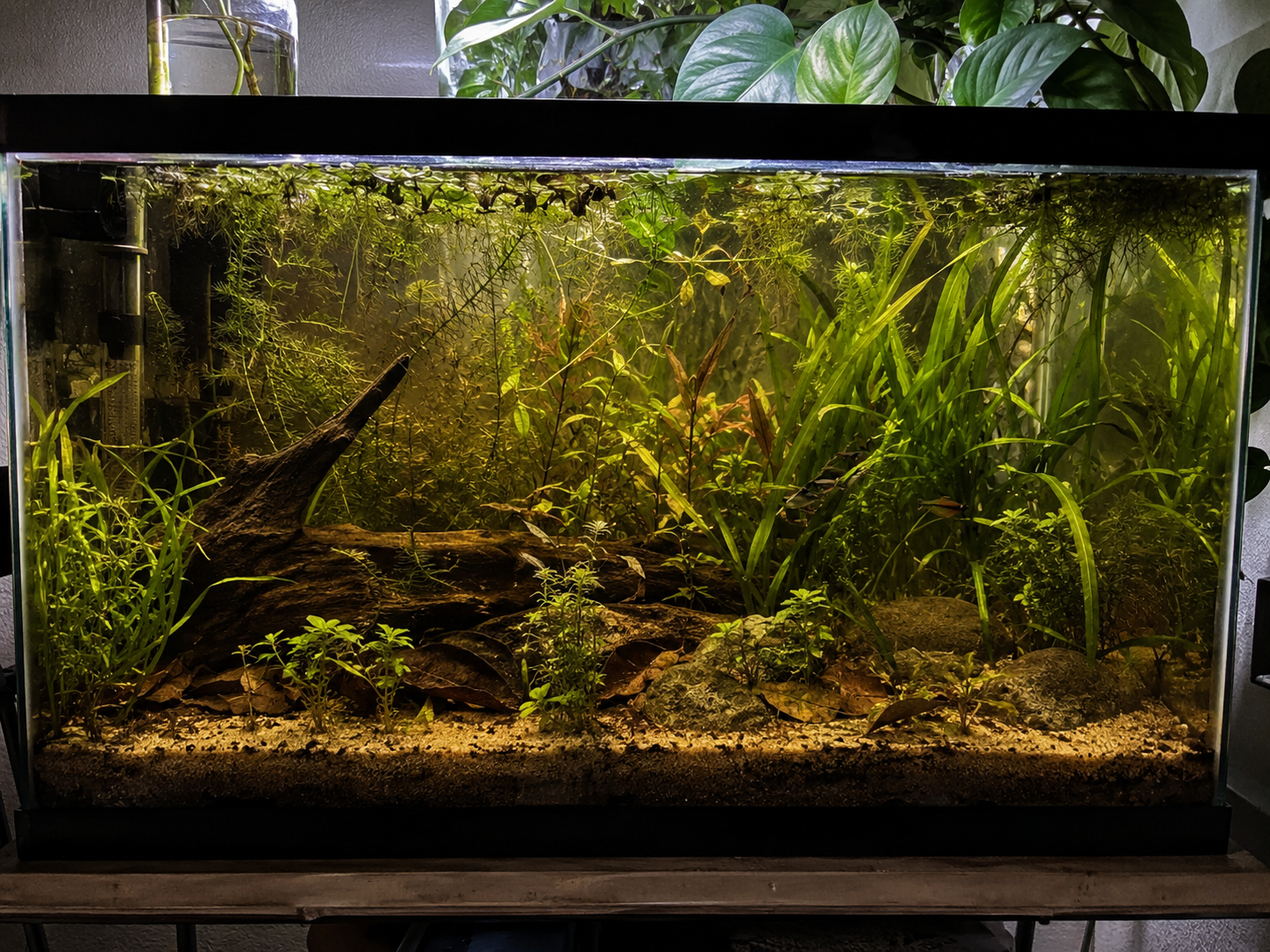
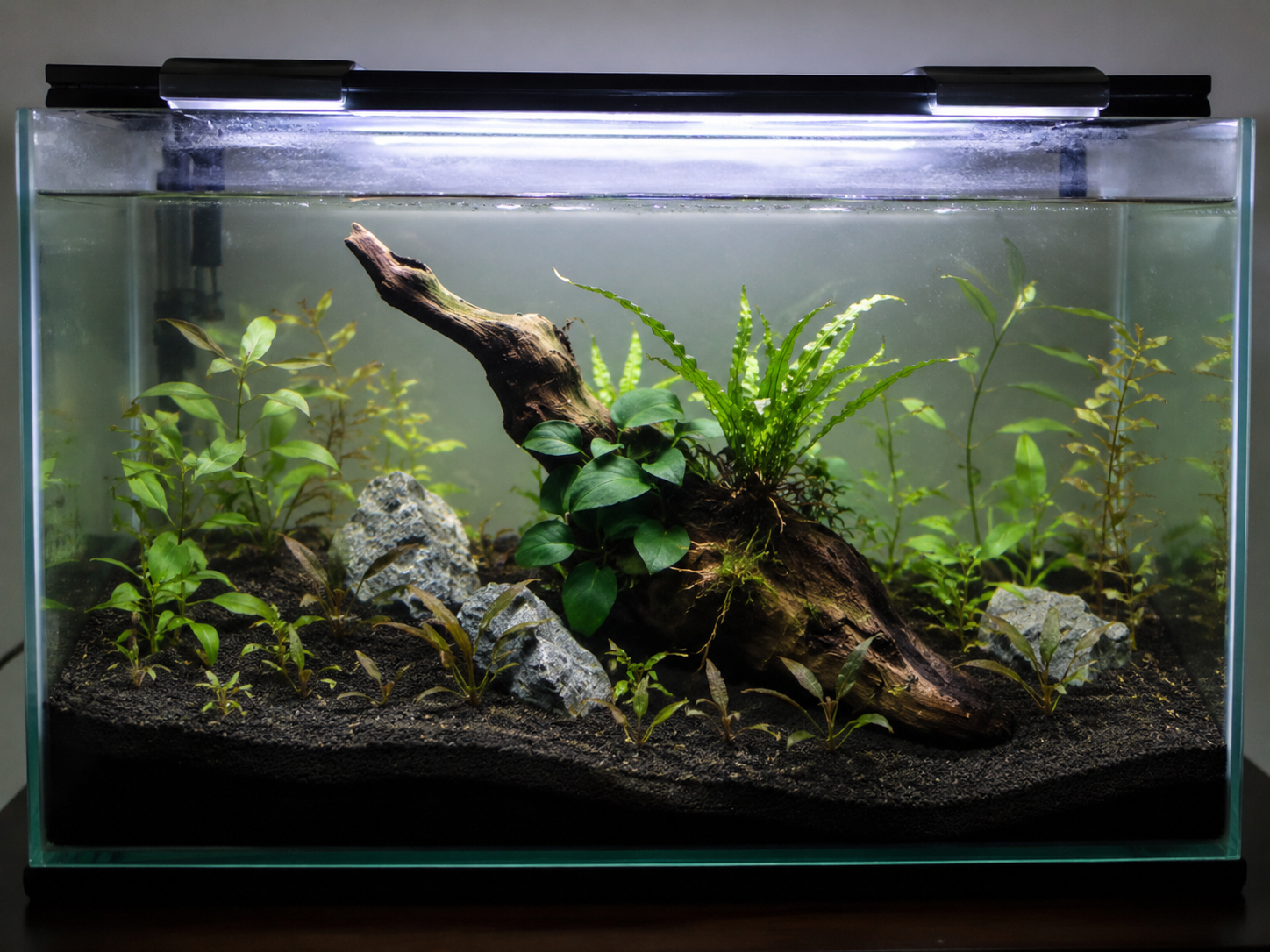
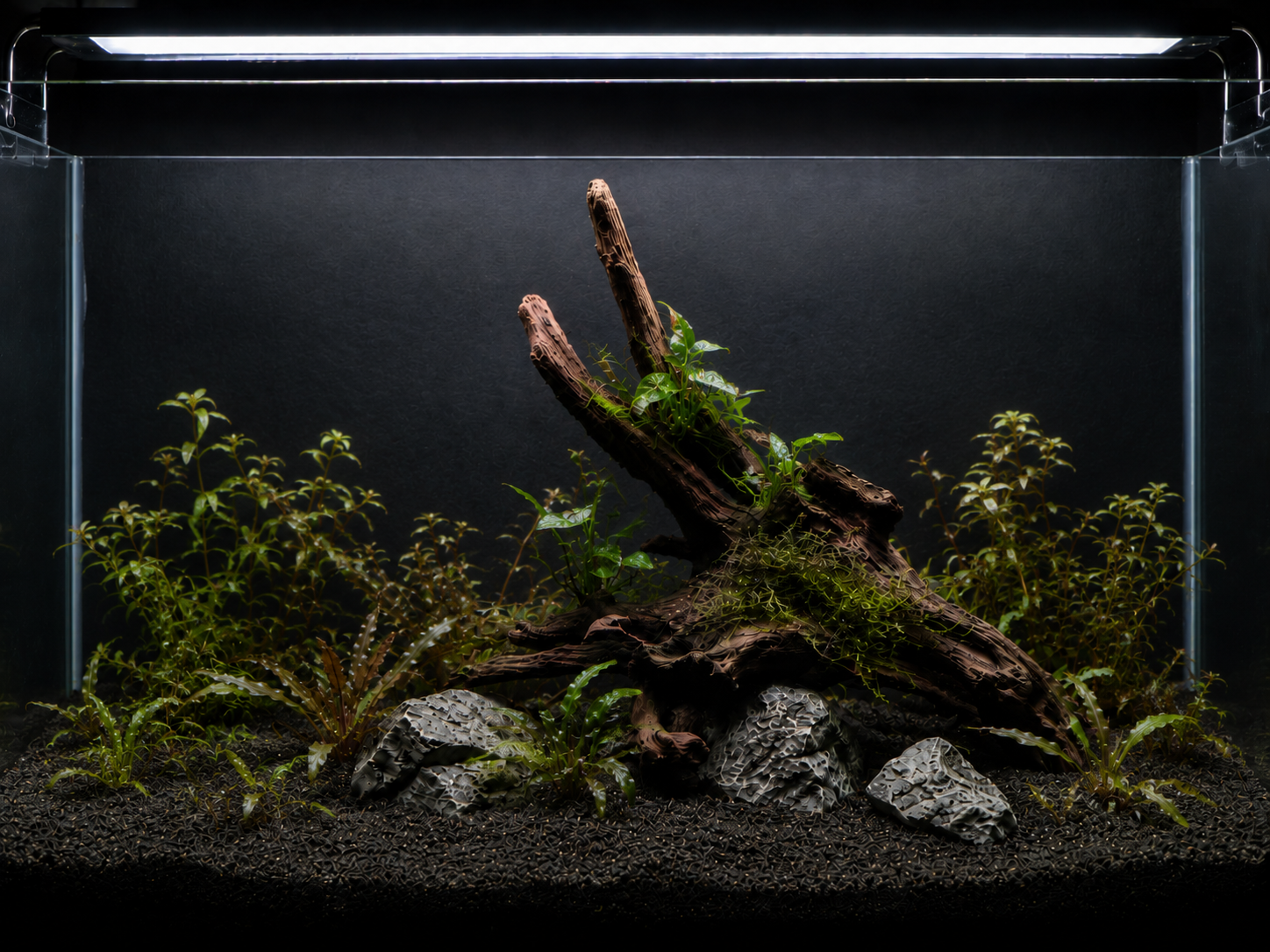
Our low-tech 10-gallon build is a good reference point for exactly this tank size — it uses one piece of driftwood with Anubias and Java Fern attached, a cluster of Crypts in the midground, a few Hygrophila stems in the background, and a handful of floaters, without looking sparse or overcrowded.
Signs you started with too few plants
You do not need a perfect day-one layout, but the tank should not feel empty after planting. Add more plant mass if you see these signs:
- The back glass is still mostly visible after planting the background.
- The substrate has large bare patches directly under strong light.
- Your only fast growers are floaters, with no submerged stems competing for nutrients.
- You chose mostly slow epiphytes and rosettes, then expected them to fill empty space quickly.
- Algae appears before the plants have put out new growth.
In that situation, the fix is usually not a chemical product. Add a handful of fast stems or floaters, shorten the light period temporarily, and let the plants take over the nutrient load.
When in doubt, ask for a bundle
If the zone-by-zone math feels like overkill, this is exactly what a bundle order solves — tell us your tank’s dimensions and whether you want a dense aquascape or a simple low-maintenance fill, and we’ll put together a species mix and quantity that matches. It’s often faster than trying to count stems yourself.