Every piece of standard aquarium advice includes some version of “do a weekly water change.” It’s good advice for a conventional setup — but it’s a workaround for a specific chemistry problem, not a law of nature. Understand the problem, and you can solve it a different way. Some of the most stable, low-maintenance tanks in the hobby run for months between water changes because they’re built to handle that chemistry without diluting it away in a bucket.
Where the problem starts: ammonia
Fish waste, uneaten food, and decaying plant matter don’t just disappear — bacteria break the proteins in that organic matter down into ammonia (NH₃ / NH₄⁺). Ammonia is directly toxic to fish even in small concentrations; it burns gill tissue and interferes with basic cell function. Every aquarium produces it continuously, for as long as there are fish or decaying matter in it.
The bacteria that make an aquarium livable
Left alone, ammonia would climb until it killed everything in the tank. What actually happens is a two-step bacterial process known as nitrification:
- Ammonia → nitrite. Bacteria in the genus Nitrosomonas oxidize ammonia into nitrite (NO₂⁻). Nitrite is still toxic — it binds to hemoglobin and blocks oxygen transport in the blood, the mechanism behind “brown blood disease” in fish — but it’s a step further from the raw toxicity of ammonia.
- Nitrite → nitrate. A second group of bacteria, mainly in the genus Nitrospira, oxidize nitrite into nitrate (NO₃⁻). Nitrate is dramatically less toxic than either ammonia or nitrite — fish tolerate concentrations hundreds of times higher without acute harm.
This is “cycling” a tank: growing a large enough colony of both bacteria groups on your filter media and substrate that ammonia and nitrite get converted to nitrate as fast as they’re produced. Once a tank is cycled, ammonia and nitrite should test at essentially zero at all times.
Why nitrate is the one that builds up
Here’s the actual problem a water change solves: a standard aquarium has no built-in pathway to remove nitrate. Ammonia gets consumed by bacteria converting it to nitrite. Nitrite gets consumed by bacteria converting it to nitrate. But nitrate is the end of that chain — there’s no third bacterial step running in a normal, oxygen-rich tank to take nitrate any further. It just accumulates, week over week, until something removes it.
That “something” is usually a water change: physically remove a portion of the nitrate-laden water and replace it with fresh water that has none. It works, but it’s dilution, not a cycle — you’re not solving the accumulation, you’re resetting it on a schedule.
The alternative: give nitrogen somewhere else to go
A true no-water-change tank isn’t skipping this chemistry — it’s routing the nitrogen through a different exit before it ever becomes a pile of dissolved nitrate. There are three practical ways to do that, and they stack well together.
1. Dense planting and soil biology (the Walstad approach)
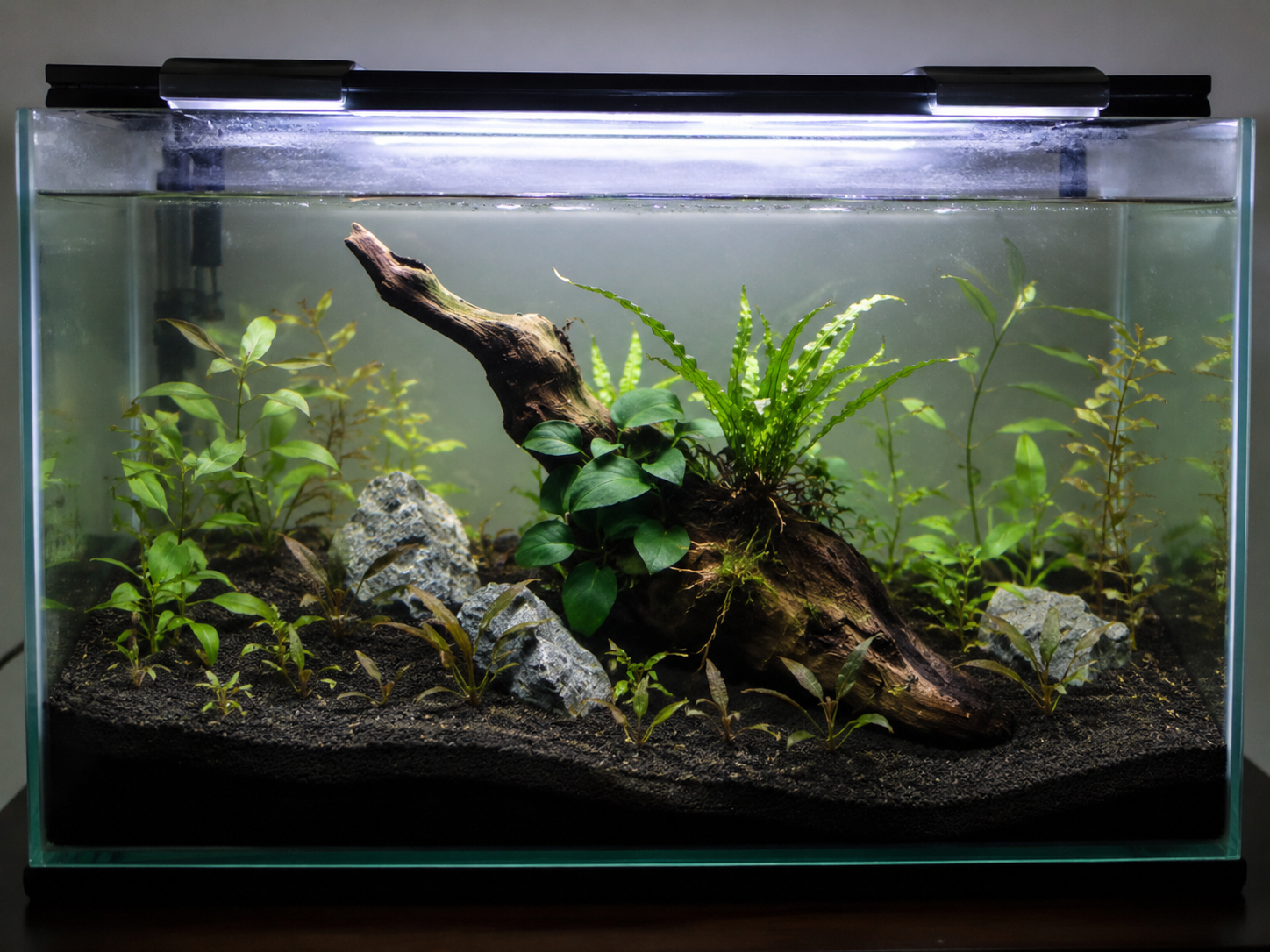
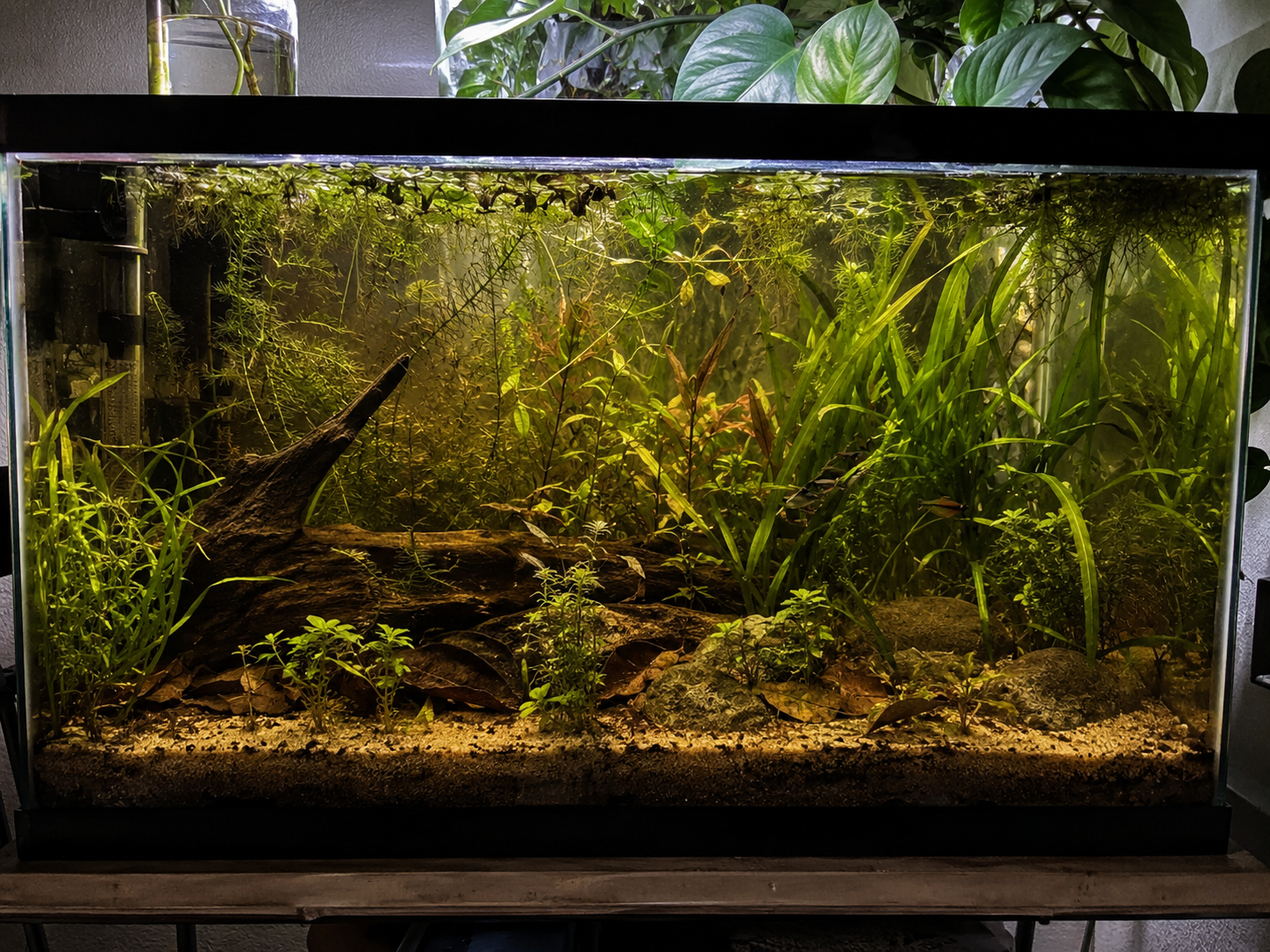
Plants absorb ammonia and nitrate directly through their roots and leaves as a nutrient source — every molecule a plant takes up is one that never becomes standing nitrate in the water column. The Walstad Method takes this further by using an organic soil substrate that feeds the plants directly, so dense root systems are intercepting ammonia at the source, in the substrate, before it even fully enters the nitrification pathway in the water. It also creates small anaerobic pockets where a third, less-discussed bacterial process — denitrification, the conversion of nitrate back into inert nitrogen gas — can actually occur. It’s the closest thing in this hobby to a tank with a real nitrogen exit, not just a nitrogen sink.
2. Floating plants
A submerged leaf pulls CO₂ from water, where it’s scarce and slow to diffuse — which caps how fast that leaf can photosynthesize and, in turn, how fast its roots can take up nutrients. A floating plant’s leaves sit in open air, with effectively unlimited atmospheric CO₂, while its roots trail directly in the nitrate-rich water below. That combination makes floaters some of the fastest nitrate-consuming plants available to a freshwater aquarist — see our complete guide to floating plants for the full species rundown and how much surface coverage to aim for.
3. Emersed growth above the waterline
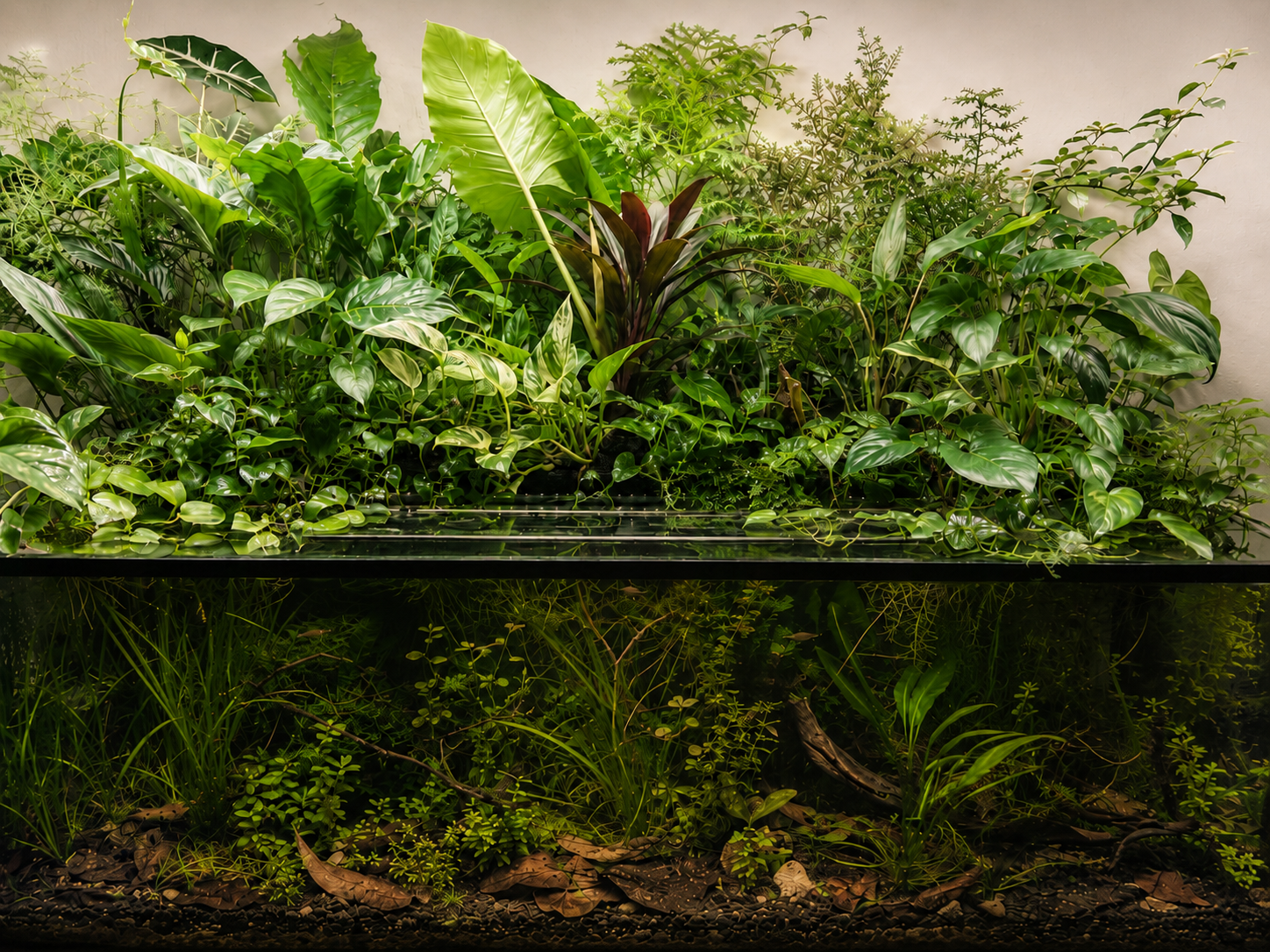
Take the floating-plant principle to its logical extreme and you get houseplants rooted straight into the tank — leaves growing entirely in open air, roots living permanently in the water. Because none of the plant’s photosynthesis is bottlenecked by dissolved CO₂, growth and nutrient uptake happen faster than almost anything grown underwater. We cover the full setup in Pothos & Friends: The Houseplants That Filter Your Tank From Above the Waterline — it’s a genuinely underrated tool for tanks that don’t want to lean on water changes.
What “no water changes” actually means in practice
None of this eliminates water changes entirely, and it’s worth being honest about that. Plant uptake handles nitrogen — ammonia and nitrate — extremely well. It does not handle everything a water change normally resets:
- General Hardness (GH) and Carbonate Hardness (KH) drift over time as minerals get consumed by plants and biological processes, independent of nitrate levels.
- Dissolved organics and tannins accumulate even in a heavily planted tank and can gradually discolor water or affect pH stability.
- Trace element depletion — a tank pulling nutrients hard via plant mass can run short on micronutrients that only a water change (or dosing) replaces.
This is exactly why even Diana Walstad’s own guidance for her method still recommends a 50% water change roughly every six months — not to control nitrate, which the soil and plants are handling, but to reset the minerals and dissolved organics that plant uptake doesn’t touch.
Putting the three pieces together
The most stable low-maintenance tanks combine all three: a soil-based substrate (or at minimum, dense root-feeding plants) handling ammonia at the source, a floating layer skimming nitrate from the water column at high speed, and — where the setup allows for it — an emersed houseplant pulling double duty as both a nitrate sink and a piece of decor above the tank. None of it is a substitute for actually understanding what’s happening chemically; it’s the reason these setups work at all instead of just delaying the same buildup by a few extra weeks. That’s exactly how I run every setup I have and all I have to do is just top them off and add some fertilizer!